
Secret Santa Gift Exchange: Budgets, Invitations, and Rules

What’s the tricky part of a gift exchange? Keeping the surprise while making sure everyone knows what to do. A little planning can help keep the giver’s identity secret until the reveal.
The exchange itself is simple: each person gives a gift to one other participant, usually without saying who they are. The organising takes a little more thought. Set a clear RSVP date, agree on a spending limit and consider a theme to help everyone choose a suitable present.
This guide explains how gift exchanges work and what to include in invitations. You’ll also find practical ways to set a budget and choose a theme, so the group can focus on the fun instead of chasing details.
Table of Contents
What exactly is this group gift exchange I speak of?
A group gift exchange is an occasion where people give presents to one another. The group can decide how gifts will be shared and when everyone will gather to exchange them.
Preparing gifts for an exchange
Organisers can set a time and place for the group to exchange gifts. That small step helps everyone know when to bring their present and gives the group a chance to enjoy the occasion together. For example, place gifts together before the exchange so they’re ready when everyone gathers.
Choosing a gift exchange format
Participants can agree on how they’ll exchange gifts before the occasion. A clear plan helps everyone understand what to expect and gives each person a practical way to prepare. The group can share the details in a message so participants have the information they need.
White Elephant is a different gift game. Players take turns choosing an unopened present or stealing one that has already been opened. For example, a group can set out wrapped gifts, then let each person choose or swap when their turn comes around. The game focuses on gifts changing hands.
Wish lists and gift choices
A wish list gives the giver useful clues, such as favourite snacks, hobbies, colours or things the recipient would rather avoid. A short list helps someone choose a thoughtful present, especially when the giver and recipient don’t know each other well. Share the list with the giver so they can refer to it while choosing a gift.
How can participants share gift ideas? A wish list can give the group useful details without requiring everyone to discuss each present together. To keep plans clear, share gift ideas in a message that everyone involved can access. The organiser can check that participants have the details they need before the occasion.
App costs and participant privacy
Which apps are free, and what do paid plans cost in Australia? Some tools offer free use, while others charge for access or extra features; pricing varies between services. There isn’t one standard Australian price. Compare what the plan includes before choosing a tool for the group.
Privacy controls vary, too. Consider what participant details an app asks for, who can see the group list and whether messages reveal more than intended. Share only the information needed to organise the occasion, and make sure participants understand how their names and contact details are handled.
How Secret Santa works
A Secret Santa exchange turns a group into a chain of private gift-giving. Each participant is randomly assigned one person, then prepares a present for that recipient. The giver’s identity remains hidden until the group decides to reveal it. For example, a family can exchange gifts at Christmas without each person having to prepare a present for every relative.
The exchange follows a simple sequence. First, the group agrees who is taking part. Next, each participant privately receives one recipient’s name. They choose a suitable gift and keep their identity quiet. At the gathering, place the wrapped presents together, perhaps under a Christmas tree, so the group can’t tell who left each one.
Confirm who is participating. The organiser needs a final group list before assignments are made. That way, each person is included in the exchange and receives someone to give to.
Assign recipients at random. Each participant is told whom they’re giving a gift to. The assignment should reach that person privately, not in a group message where everyone can see it.
Prepare and label the gift. The giver wraps a present for their assigned recipient. A recipient’s name helps the organiser put the gift in the right place, while leaving the giver’s name off keeps the surprise intact.
Exchange the presents. The group gathers the gifts before handing them out. Participants can open them together, then reveal who gave each present if that’s part of the group’s plan.
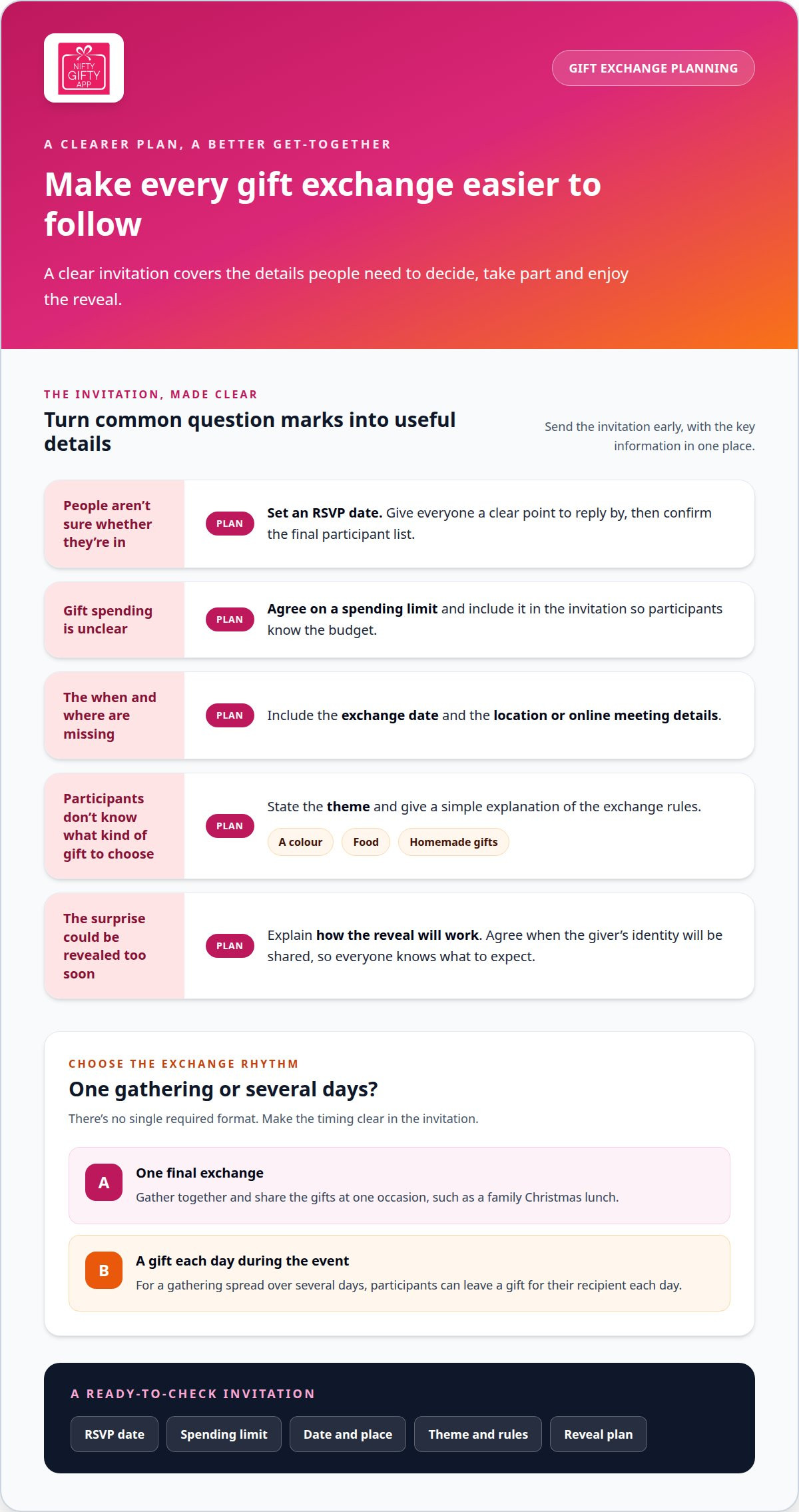
There’s no single required format for the exchange. A group might give one final gift at its gathering, or exchange one gift a day during the event. For example, colleagues meeting over several days could leave a gift for their recipient each day, while relatives travelling to one Christmas lunch could save their presents for that occasion.
The reveal is up to the group; it doesn’t have to happen immediately. Participants can keep their identities secret until the final exchange, then announce who gave each present. Agree on the timing beforehand so everyone knows whether to guess, stay quiet or sign a card. A family might reveal the givers after all the presents have been opened.
Secret Santa also differs from a White Elephant game. In White Elephant, players take turns choosing a new gift or stealing one that’s already been opened. Secret Santa instead assigns each giver a specific recipient. Choose the format that suits the gathering: private recipient assignments for a personal exchange, or turn-by-turn gift choices for a group game.
Organising this is even easier when you use the Nifty Gifty App to manage your draw without revealing gifts. Participants draw another participant’s name, give that person a gift anonymously and place gifts together where no one can identify who left each present.
Invitations and participant rules
A clear invitation gives each participant the details they need to decide and take part. Send it early, set an RSVP date and state the spending limit. Include the exchange date, location or online meeting details, gift theme and how the reveal will work. For example, a family invitation could ask guests to reply by a set date, then explain that presents will be opened together at Christmas lunch.
Can gift exchange apps exclude couples, family members or previous pairings? Some generators let organisers set exclusions, while others don’t. If a pairing matters, agree on the rule before assignments are made and choose a method that can apply it.
Do gift exchange apps require an account, email address or phone number? Requirements vary. Some apps ask participants to register or provide contact details; others let the organiser share assignments another way. Tell participants what information they’ll need before they accept, especially if relatives are joining from different parts of Australia.
An RSVP date matters because the participant list affects the whole exchange. If someone replies after assignments are made, the organiser may need to adjust the group. Make the deadline easy to spot. A line such as “Please reply by Friday so the organiser can finalise the list” gives everyone a clear next step without a long message chain.
Spell out the rules that might otherwise prompt a dozen follow-up messages. Cover these points in the invitation:
Who can join: List the family, workplace team or group invited to participate.
What to give: Explain whether the exchange has a theme, such as homemade gifts or a particular colour.
How much to spend: State one agreed price limit so participants can plan on the same basis.
When and where to exchange: Include the gathering details and the planned reveal.
How to handle exclusions: Invite people to raise pairing restrictions privately before assignments are made.
Keep the wording welcoming and specific. For a family spread across Australia, explain whether someone can participate remotely and how their gift will reach the recipient. Don’t assume everyone can attend in person or interpret “small gift” the same way.
Finally, share changes with the whole group. If the date moves or a participant withdraws, send one updated message with the revised details. That gives everyone the same instructions and helps the organiser keep the exchange on track.
Send the invitation early so participants have time to decide whether they can join. Set an RSVP date and gift price limit in the same message, making both easy to find. If the participant list must be final before assignments are made, highlight the deadline. A brief reminder can restate the RSVP date and limit, so everyone makes a decision with the same expectations in view.
Online gift coordination tools
Online gift coordination tools can help an organiser keep track of who is giving a gift and what each person would like. They can suit a family spread across Australia, since participants don’t need to gather in one room to share gift ideas and practical details.
Offline alternatives to apps
A paper-based process can help keep gift ideas together without an app, which suits groups that prefer a simple offline method. Write each participant’s name and gift ideas on a sheet, then have one trusted organiser share the relevant details with the group. This works well when the organiser can keep the information up to date.
Another option is for one organiser to keep a list and contact each participant individually. For example, they could send each person a private message with the gift ideas they need. Don’t post personal details in a family group chat if participants would rather keep them private.
What are useful alternatives to an app for organising gift ideas? Use a paper list managed by one organiser, or have the organiser privately share relevant details with each participant. Both methods require someone to manage the information and keep it up to date.
Gift coordination tools for Australian groups
There isn’t one tool that suits every Australian group; the right choice depends on how participants share gift ideas and what the organiser needs. A family with relatives in different parts of Australia may value easy access to shared details, while a small workplace team may prefer a straightforward method with simple instructions.
What should Australian groups look for in a gift coordination tool in 2026? Choose based on your group’s needs rather than a general ranking: consider how participants access gift ideas, what details are required to take part and whether the organiser can keep information up to date. Those features affect whether the organiser can keep the arrangements organised.
Before adding names, the organiser can check how a tool handles practical details. Can participants access the gift ideas they need? Can the organiser update the list when plans change? Does taking part require an account or contact information? The answers help the group choose a method that suits its privacy preferences and avoids collecting unnecessary details.
Once the group is ready, the process is simple:
Finalise the participant list. Add only people who have agreed to take part.
Gather gift ideas. Confirm preferences and any useful details before people prepare their gifts.
Share information appropriately. Give each participant the details they need to choose a gift.
Keep updates consistent. If someone’s plans change, tell the organiser promptly so the arrangements can be updated.
With an online tool, the organiser manages participant details and shares gift ideas with the group. With a paper list, the organiser handles that task directly. Either way, keep personal details private and share practical updates with the people who need them.
Spending limits and themes
A spending limit gives everyone a shared budget for the exchange. Agree on one amount before assignments go out, then include it in the invitation. That helps a participant choose a suitable present without guessing whether the group expects something elaborate. A gift exchange might set a $5 limit as an example, but the group should choose an amount that suits its own plans.
Make the spending rule clear. Say whether the limit applies to the gift itself or the total cost, including extras such as wrapping or delivery. Participants may interpret “small gift” differently, while a stated amount gives everyone the same starting point. If the group wants homemade gifts, clarify whether they count towards the limit.
For a fair exchange, agree on the spending limit together before the draw. A family could settle on an amount that feels comfortable for adults and older children, while a workplace group could choose a limit that works across different budgets. Avoid changing the figure after participants have started choosing presents. If the plan changes, tell the whole group promptly.
A theme gives gift-givers a useful starting point without dictating one exact present. Choose a simple idea everyone can understand, such as food, homemade items, a colour or a Christmas decoration. A “green gift” theme could inspire a green notebook, a plant or a handmade card. A food theme could include a favourite snack, a locally made treat or something baked at home.
Choose a theme that leaves room for different tastes and circumstances. A homemade-gift theme can suit someone who enjoys crafting, but may not suit every participant. Food can be a friendly option, though the organiser can invite people to share dietary needs privately. A colour theme offers a clear prompt without requiring specialist knowledge or materials.
Before announcing the theme, consider whether participants can interpret it in several ways. A Christmas decoration might mean an ornament, a table decoration or a festive card. That flexibility makes it easier for people with different interests to take part. If a theme needs explanation, add an example to the invitation rather than leaving participants to guess.
Set one shared limit: State the amount plainly and explain what it covers.
Choose an open theme: Food, homemade items, a colour or a Christmas decoration can guide ideas.
Allow personal choice: A theme should inspire presents, not force everyone towards the same item.
Share updates with everyone: Keep the limit and theme consistent if plans change.
Once the limit and theme are settled, include both in the invitation and participant instructions. For example, “Choose a homemade gift within the agreed limit” gives the group two clear boundaries. That shared understanding lets each giver focus on a thoughtful choice for their recipient.
Nifty Gifty App
Nifty Gifty App helps organisers keep gift lists and group contributions together for an occasion. Organisers use the mobile app on iOS or Android, while guests can claim gifts through a secure link or QR code without downloading an app or creating an account. Claims update in real time.
It’s useful when your group also needs a shared place to track gift ideas or group contributions. The app shows a live running total, but contributors arrange payments themselves. It doesn’t sell gifts or process payments.
There’s a 14-day free trial, then $7.99 a year. If you’d like help organising your gifting, contact Nifty Gifty App.
Set your next exchange up for success
Give the next organiser a head start by noting what worked for your group and what you’d change. A short handover can capture the preferred reveal, invitation wording or theme, so planning the next exchange starts with useful decisions already made. Keep the notes somewhere the organiser can find them when the occasion comes around.
For the wider gift planning around an occasion, Nifty Gifty App can help keep your group’s gifting organised. Guests can claim gifts through a secure link or QR code, with no app download or account needed. Use the app for gift planning, while your group handles the other parts of the exchange.
Ready to bring gifting plans together? Contact Nifty Gifty App and take the next step towards a thoughtful celebration. Your group can handle the details, then enjoy the moment together.
Frequently Asked Questions
How do you set up a Secret Santa draw and invite participants using an app?
Use an exchange generator to create the event, add confirmed participants, then send invitations with an RSVP date, gift limit, theme and exchange date. After replies close, its private assignment feature sends each participant their recipient separately. Check any exclusion settings before invitations go out, as options vary between tools. Keep assignment details out of group chats, especially if the organiser is also taking part.
Can participants add wish lists without revealing their chosen gifts?
Yes, if the app keeps gift ideas separate from each giver’s planned present. Participants can share preferences while keeping their own choice private. Nifty Gifty App supports shared gift lists and real-time gift claims, helping groups track which listed gifts remain available. It doesn’t assign Secret Santa recipients, so use a separate method to tell each giver whom they’re buying for.
Which Secret Santa apps let participants keep gift choices hidden from the recipient?
Look for Secret Santa generators that privately send each assignment and don’t show the giver’s planned present to the recipient. Features differ between apps, so check which details are visible to the group.



Comments