
How to manage family arguments over gifts and expectations

A gift can be generous and still feel like a criticism. Knowing how to manage family arguments over gifts starts with separating the present from the feeling underneath it: someone may be reacting to cost, fairness, family traditions or an expectation no one has said aloud.
It’s understandable to want everyone to feel considered, especially if you’re keeping track of what each person expects. But you don’t have to settle every disagreement at once. A calm pause, a clear conversation and room for different values can stop one awkward comment from taking over the occasion.
This guide explains what commonly fuels family tension over gifts and how to decide which disagreements need attention. You’ll find practical ways to discuss budgets, traditions and what gift-giving means to your family, along with considered responses to difficult or passive-aggressive comments. The aim isn’t to make everyone agree. It’s to clarify expectations and protect the relationships that matter.
Table of Contents
1. Common causes of family conflict
Gift arguments often start with expectations no one has stated aloud. One relative may see an expensive present as generous, while another feels pressured to spend more. Families can also disagree about fairness: should every child receive gifts of similar value, or should presents reflect individual interests? These differences can feel personal when people assume their own approach is obvious. Asking, “What matters most to us this year?” can reveal whether the disagreement is about money, tradition or feeling appreciated.
Misunderstandings add fuel. A late reply about a gift plan might seem like indifference, even if the person is busy or unsure what to suggest. Unresolved concerns can then resurface at a family gathering, alongside other pressures. Trying to create a perfect Christmas can exhaust the person organising, cooking and cleaning, especially if nobody else has been asked to help. Name the practical pressure as well as the gift disagreement: “I’m juggling the meal and presents, so I need us to share the planning.”
Conflict can also affect health. Family arguments can raise blood pressure and trigger the release of stress hormones. During a heated exchange, people may struggle to listen, making it easier to mistake assumptions for facts. Pause the conversation if voices rise or people talk over one another. Then return to one specific issue, such as coordinating children’s gifts, instead of bringing up every past disagreement.
Children can feel the strain of parental conflict, even when the argument is about presents. Ongoing arguments may contribute to insecurity, low self-esteem and hopelessness. Where possible, discuss disagreements privately rather than arguing in front of children. If they have heard the exchange, explain plainly that the disagreement is between adults, isn’t their fault and that you’re working on a solution. Avoid saying a child has “ruined Christmas”; blame can intensify distress rather than resolve the issue.
Choose a calmer moment to address the disagreement. If a gift exchange has become tense, wait until everyone can speak and listen without interrupting. Describe what happened, explain its effect and ask what the other person understood. For example: “When the presents were compared, I felt uncomfortable. What were you hoping we’d agree on?” This gives everyone room to clarify their meaning before deciding on a practical way forward.
Make the next step concrete. Agree who will coordinate the children’s presents, whether relatives will share ideas beforehand, or how the family will handle different traditions. A clear agreement reduces guesswork. A calm follow-up keeps one awkward exchange from becoming the only conversation that matters.
Misunderstandings can arise when relatives jump to conclusions. Anger can make it harder to listen, escalating conflict and fuelling arguments. Wait until everyone is calm before addressing the issue.
Trying to create a perfect Christmas and cater to everyone can exhaust family members and cause resentment, particularly when one person organises, cooks and cleans. Ongoing conflict can cause stress and damage relationships. Reassure children that an argument isn’t about them and that the adults are working on a solution.
2. Choosing which disagreements to address
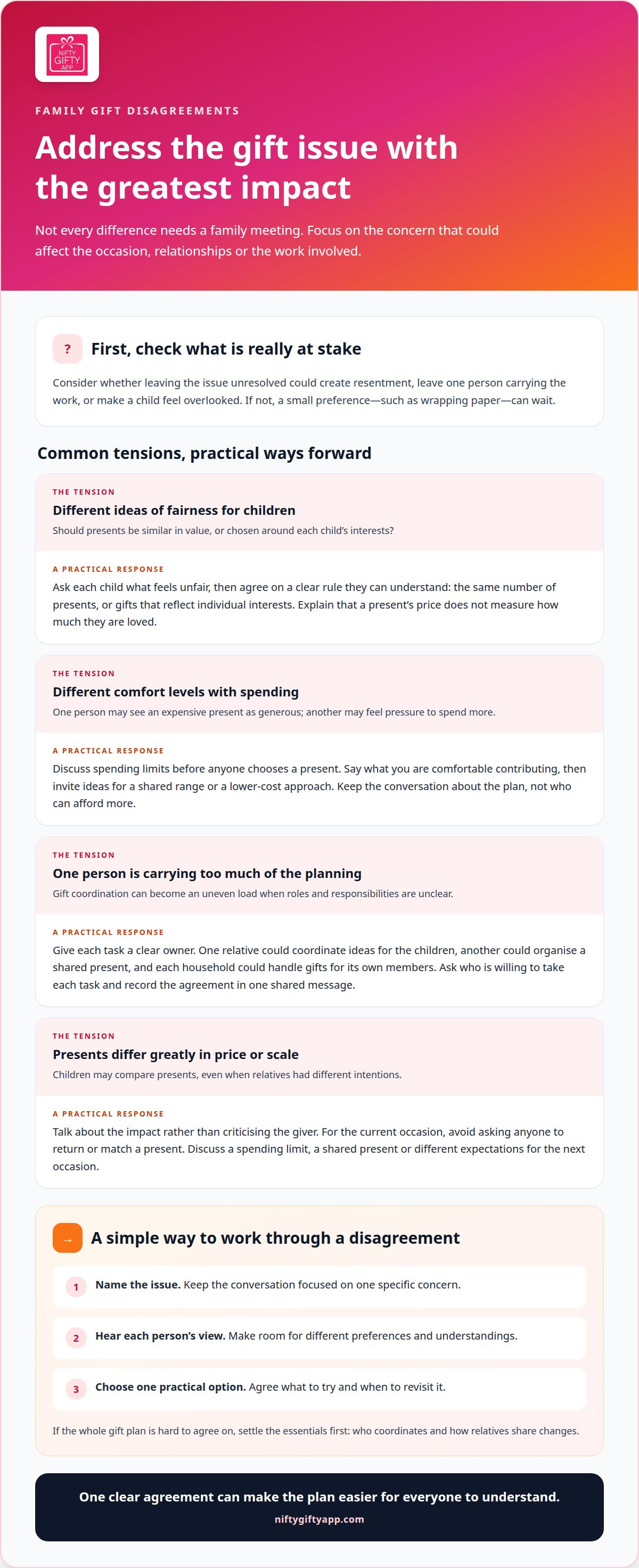
Not every difference needs a family meeting. A useful part of how to manage family arguments over gifts is choosing the issue that most affects the occasion, such as whether children receive separate presents or one shared gift. Ask what might happen if it stays unresolved. If it could create resentment, leave someone carrying all the work or make a child feel overlooked, address it. A preference about wrapping paper can probably wait. Prioritising keeps small irritations from escalating and protects relationships from endless debate.
Discuss spending limits before anyone chooses a present. Say what you’re comfortable contributing, then invite relatives to suggest a shared range or a lower-cost approach, without asking them to explain their finances. For example, the family might agree on one present per child rather than matching every purchase. Keep the conversation about the plan, not who can afford more.
When children disagree, focus on the need behind the complaint. Ask each child what feels unfair, then agree on a rule they can understand, such as giving each sibling the same number of presents or choosing gifts around their individual interests. Fairness doesn’t always mean identical items. Explain differences calmly, and remind children that a present’s price doesn’t measure how much they’re loved.
Extended family can divide gift-giving responsibilities by assigning clear roles. One relative could coordinate ideas for the children, another could organise a shared present, and each household could handle gifts for its own members. Ask who is willing to take each task, then record the agreement in one shared message. Giving each job a clear owner helps prevent one person from being expected to plan, remind everyone and follow up.
When one person gives an expensive present and another gives something modest, address the impact rather than criticising the giver. You could say, “I’m concerned the children will compare the presents. Could we agree on an approach for next time?” For the current occasion, avoid demanding that anyone return or match a gift. Discuss whether the family wants a spending limit, a shared present or different expectations for future occasions.
For a disagreement that needs solving, keep the discussion focused: name the issue, hear each person’s view, then brainstorm options. Choose one practical option to try and agree when to revisit it. Negotiation may involve compromise, or accepting different preferences while setting a shared boundary. If nobody agrees on the whole gift plan, settle the essentials first, such as who coordinates and how relatives communicate changes. Leave less important differences for now.
Knowing how to manage family arguments over gifts also means deciding what can wait. A small, specific agreement gives everyone something useful to work with, without requiring the whole family to agree on every detail.
3. Letting go of idealised holiday expectations
Christmas expectations can grow from family traditions, social media and memories of earlier celebrations. Trying to recreate a picture-perfect day can stretch physical, financial and mental resources. One person may expect a long lunch, matching decorations and thoughtful presents, while another hopes for a quiet afternoon. Write down what each person considers essential. You’ll see which expectations are shared and which are personal preferences.
Psychotherapist Philippa Perry advises families to lower their expectations of Christmas and avoid competing over gift size. Put that into practice by choosing a few details that make the day special, such as a favourite meal or time together, then simplifying the rest. If elaborate decorations take hours, choose one meaningful item instead. If gift comparisons tend to sting, agree not to rank presents or discuss their prices.
Make a practical plan before the holiday arrives. Choose the traditions your family wants to keep, then give each one a clear role and a realistic amount of effort. For example, one household might host lunch while another brings dessert. If relatives live in different cities, agree on a time for a call instead of expecting everyone to travel. A smaller plan can still feel thoughtful when expectations match what people can manage.
Acceptance doesn’t mean pretending you’re happy with every change. It means noticing your feelings without insisting the day follow an old script. If a relative can’t attend, acknowledge the disappointment and choose one way to include them, such as sharing photos afterwards. If children prefer familiar activities to a full day of visiting, build in a quiet break. Clear choices give family members room to enjoy the occasion differently.
Separate what you hope will happen from what you can control. You can set a welcoming tone, share tasks and explain gift plans; you can’t make every relative equally excited. If a present doesn’t get the reaction you imagined, pause before treating it as a verdict on your relationship. Ask what the moment means to you, then respond to that feeling directly. This keeps one unexpected reaction from defining the whole celebration.
Have a brief expectations check-in before Christmas plans are fixed. Ask each person to name one thing they’re looking forward to and one thing they’d like to keep simple. A parent might choose a relaxed breakfast; a grandparent might value everyone opening presents together. Agree on a workable version and leave room for plans to change. The aim isn’t a flawless holiday, but a day shaped around what your family can genuinely share.
Christmas can feel high-pressure when physical, financial and mental resources are stretched. Keep the check-in focused on choices that reduce strain: agree which plans are optional, and make it clear that changing or dropping one is acceptable. A shared understanding can help everyone protect their energy and focus on what matters, without treating a simpler celebration as a failure.
4. Discussing the values behind gift-giving
A gift can express affection, tradition, surprise or practical help, depending on the person giving it. Ask relatives what they hope a present will express before debating the item itself. One person may value a carefully chosen book, while another sees time together as the meaningful part. Naming those differences can shift the conversation from “Who spent more?” to “What would help us feel appreciated?”
Psychotherapist Philippa Perry says children’s attention and being played with matter more than gifts. That idea can guide a family conversation without making presents seem unimportant. Ask children what they enjoy doing with each relative, then plan a shared activity alongside gift-giving. A game, walk or baking afternoon can create connection without turning the occasion into a test of who gave the most.
For low-cost or non-material alternatives in Australia, offer shared time, a handwritten note, a home-cooked meal, a beach walk or help with a practical task. Choose something that suits the recipient, such as a backyard game with a child or a long chat with an older relative. The value lies in the thought and attention, not the price tag.
Be specific about your own values. Try, “I like giving something useful, but I don’t want anyone to feel pressured to match it.” Then invite each relative to describe what they enjoy about giving or receiving presents. Listen for the need behind the preference: a family member who wants everyone included may care more about fairness than matching gifts. Understanding that need makes a resolution easier to reach.
Show appreciation in ordinary words. Tell a relative you value the time they spent choosing a present, or thank someone for organising the family gathering. A child can draw a thank-you picture or name one thing they enjoyed doing with the giver. These small gestures remind family members that care can be expressed through attention, effort and kindness, not only through an object.
If family members value different things, agree on a shared principle rather than forcing identical tastes. You might decide that gifts should reflect the recipient, while nobody is expected to match another person’s spending. Or choose a family tradition, such as giving one thoughtful present and sharing an activity. Put the principle in simple language, then use it as a guide next time expectations clash.
Keep the conversation open to change. A family’s needs may shift as children grow, relatives move or circumstances change. Before the next occasion, ask whether the current approach still feels right. Giving is one way to show care, not a measure of who loves whom more. Remembering that can help relatives discuss presents without treating different preferences as a judgement of their relationships.
5. Responding to awkward or passive-aggressive comments
A comment like “I suppose some people can afford nicer presents” can sting, especially in front of relatives. Sarah Turner advises pausing before responding, so you can choose your words rather than fire back. Take a breath, then ask, “What did you mean by that?” A calm request for clarification gives the speaker a chance to explain and helps you avoid guessing their perspective.
If the comment raises a fair concern, acknowledge that part without accepting an unfair accusation. For example: “You’re right that we didn’t discuss spending limits. I’d like us to agree on them before the next occasion.” Sarah Turner notes that recognising a kernel of truth can help the other person feel heard. Keep your response specific, and explain how the comment affected you without labelling the other person’s behaviour.
For an unwanted or duplicate gift, thank the giver for thinking of you, then raise the practical issue privately. You might say, “That was thoughtful of you. I already have one, so would you mind if I exchanged it?” If an exchange might cause hurt, focus on what would be useful next time rather than criticising the present.
If a relative ignores a gift rule, parents can calmly restate the boundary away from the children. For example: “We agreed to avoid noisy toys. We’ll put this one aside today, and let’s talk about suitable gifts before the next family gathering.” Briefly explain the reason, such as a child’s needs or a household rule. Avoid blaming the child or saying they’ve spoiled the occasion.
To de-escalate an argument, stop debating the gift and lower the tension first. Pause, speak politely and let each person finish before responding. Use an “I” statement, such as, “I feel uncomfortable discussing present prices in front of the children.” If anyone is too angry to listen, take space and agree to return to the topic within a day or two.
When you resume, stick to one issue and one next step. Ask what each person wants to happen, then suggest a practical option, such as sharing gift ideas privately or agreeing on a family limit. If the conversation starts escalating again, say, “I want to sort this out, but I’m not able to talk calmly right now.” Set a time to continue rather than leaving the disagreement open-ended.
Parents can model repair after a tense exchange. If you snapped at a relative, say, “I’m sorry I raised my voice. I was frustrated, but I should have explained that more calmly.” This shows children how to take responsibility without pretending the original concern has disappeared. A respectful boundary and a sincere apology can sit side by side.
Nifty Gifty App
Nifty Gifty App helps family organisers keep gift plans clear once expectations are agreed. Use the mobile app to create an occasion gift list and share it with relatives through a secure link or QR code. Guests can claim gifts in their browser without downloading the app or creating an account. Claims update in real time, so relatives can see what’s already covered.
Planning a shared present? Contributors can contribute, while the app tracks the total in real time. Payments are handled separately: the app doesn’t collect or process them. It won’t resolve a difficult family conversation, but it can make the agreed plan easier to follow, especially when relatives live in different places.
If you’d like help keeping family gift plans organised, contact Nifty Gifty App.
Make the next occasion feel more like your family
Family traditions don’t have to stay fixed to keep their meaning. Use the next occasion to agree on one small change that suits the people involved now. Perhaps your family shares the organising, makes more room for time together or checks expectations before plans take shape. Make the agreement practical, not perfect.
Learning how to manage family arguments over gifts takes patience, especially when old habits or tender feelings are involved. You can still choose a calmer next step: speak plainly, keep the conversation respectful and leave room for relatives to see things differently. A thoughtful plan can support connection without asking everyone to give or receive in exactly the same way.
If you’re ready to put an agreed gift plan in one place, organise your next occasion with Nifty Gifty App. Take the pressure off remembering every detail, and make more room for the parts of giving your family enjoys.
Frequently Asked Questions
How can families set clear expectations about gifts before holidays or birthdays?
Agree on practical details together before gift plans begin. Decide who is included, whether presents are individual or shared, and how surprises will be handled. For example, a family could agree that relatives check with parents before choosing gifts for young children. Put the decisions in one message everyone can refer to, and invite people to speak up if the plan doesn’t suit them.



Comments