
How much should you spend on each person? A gift budget
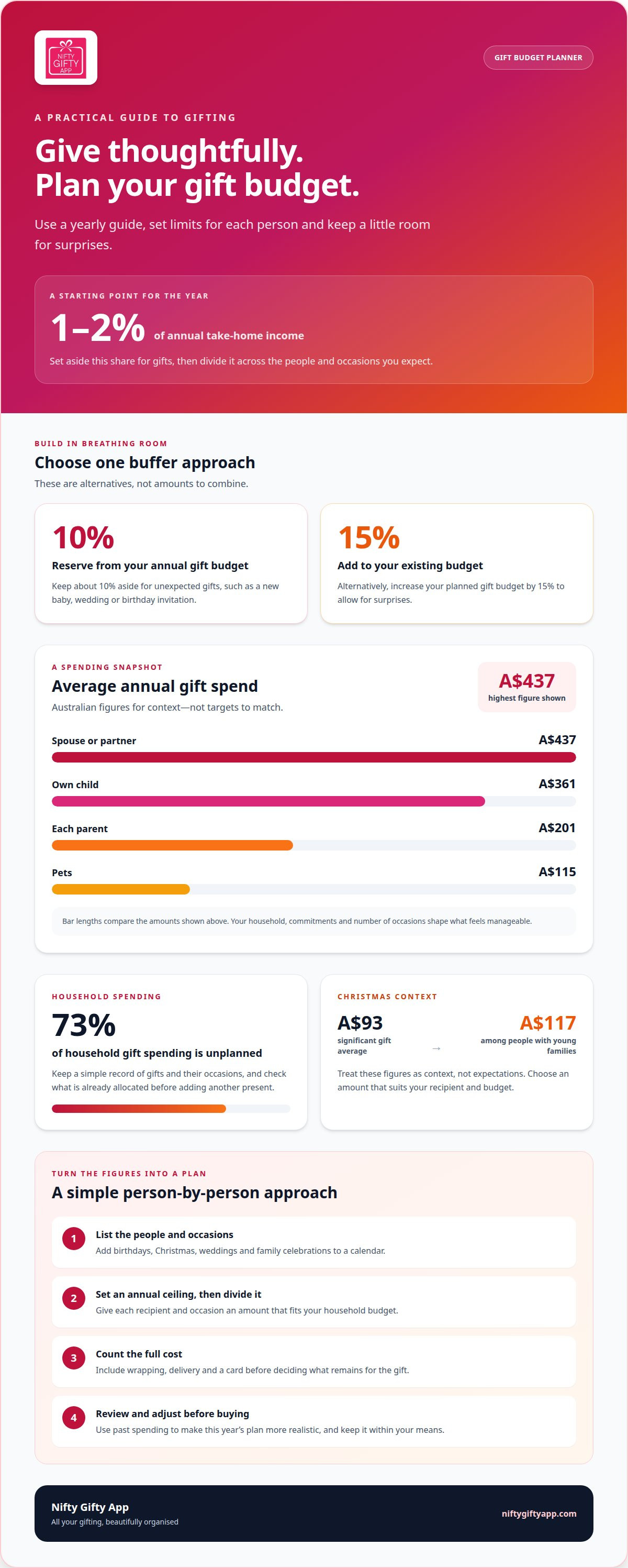
You don’t need one fixed dollar figure for everyone. A common starting point for a gift budget per person is to set aside about 1% to 2% of your annual take-home income for gifts, then divide that amount across the people and occasions you expect. Keep around 10% of your annual gift budget for unexpected gifts, too.
Birthdays, Christmas and the occasional thank-you can quickly add up when you decide on each gift separately. A plan helps you give generously without letting every occasion create a new spending limit.
Learn how to set a realistic amount for each recipient, allow for surprise gifts and choose thoughtful alternatives when spending more isn’t practical. We’ll also cover gift exchanges, a simple way to share the fun while buying fewer gifts.
Table of Contents
1. Setting aside a buffer for unexpected gifts
A birthday invitation, a new baby or a wedding can add an unplanned gift to your calendar. Instead of taking money from another occasion, build a buffer into your annual gift budget. One approach is to reserve about 10% for unexpected gifts. Another is to add 15% to your existing budget. Treat these as alternative methods, not amounts to combine.
Start with the occasions you expect. Add birthdays, Christmas, weddings and family celebrations to a calendar, then estimate how many gifts you’ll give. Set aside a separate buffer for unexpected invitations, so you can use it without cutting the amount planned for another recipient.
Workplace and tax questions are separate from choosing a comfortable gift amount. For Australian staff gifts, tax treatment depends on the per-person figure, not just the total budget. When giving at work, plan gifts at equivalent values while allowing different items for dietary needs or personal preferences.
Practical, versatile gifts can help you manage your budget. Choose something suited to a range of recipients, such as a book by a favourite author, pantry treats with clear ingredient labels or a plant for someone who enjoys gardening. Check dietary needs before buying food, and have a non-food option ready for anyone with allergies or restrictions.
Buying in bulk can simplify gifting when several people have similar tastes. For example, buy a batch of the same locally made pantry item, then add a handwritten note for each person. Keep the amount per recipient consistent where fairness matters, especially for staff, while choosing items that suit individual needs.
Sharing costs can make a meaningful gift more manageable. If relatives want to give one larger present for a milestone birthday or wedding, agree on the total and each person’s contribution before buying it. The recipient gets one considered gift, and no one has to cover the full cost alone.
Keep your plan within your means. Set a limit that leaves room for household bills and other commitments, then use it to guide your gift choices rather than raising it under social pressure. If the buffer runs low, offer a card, a useful favour or a smaller personal gift. Thoughtful giving doesn’t mean spending beyond your budget.
Spending on spouses, children, parents and pets
Start with the people and occasions, then shape each amount around your relationship and household budget. Australian averages offer context, not a required price tag: people spend A$437 a year on gifts for a spouse or partner, A$361 for their own child, A$201 for each parent and A$115 for pets.
Use those figures as a prompt to review your own spending, not as targets to match. Your family size, commitments and number of occasions all affect what feels manageable. A child’s birthday might take priority this month, while a shared meal or handwritten card could suit a parent’s occasion.
There isn’t a typical Australian gift budget for each age group in these figures. A general starting point is to allocate about 1% to 2% of annual take-home income to gifts, then adjust for your recipients, occasions and financial commitments.
Set a limit for each occasion as well as each person. For example, one family might agree on A$50 per child and A$25 per adult for a particular celebration. Another might reserve more for a milestone birthday and less for an ordinary holiday gift. The useful limit is the one your household can follow without taking money from essentials.
Expectations matter, but they don’t have to set the price. Talk with relatives before birthdays or Christmas and suggest a shared spending cap. Larger families might focus gift-giving on children, or adults might agree to exchange cards instead. A clear conversation helps everyone understand the plan and feel appreciated without guessing what others will spend.
Include the full cost of giving in your limit for each occasion. If you’re paying for wrapping, delivery or a card, count those costs too. Set them aside before deciding how much remains for the gift itself. For a relative in another city, for instance, budget for delivery first, then choose a present within the remaining amount.
Unplanned spending can quietly push a household over its intended limit. In Australia, 73% of household gift spending is unplanned. Keep a simple record of purchases and the occasion they’re for. Before adding an extra present, check what’s already allocated to that person and whether the new expense fits.
Christmas figures can also help with planning. Australians spend an average of A$93 on a significant Christmas gift, rising to A$117 among people with young families. Treat these as context, not expectations. A thoughtful present that suits your recipient and budget can be appreciated without matching an average.
Age-based gift amounts aren’t established here; an income-based guide is to set aside roughly 1%-2% of annual take-home pay, adjusted for household commitments.
3. Setting a person-by-person gift budget
Start with one annual ceiling, then divide it between recipients and occasions. This turns a vague yearly intention into limits you can use when planning.
Next, break the overall amount into person-by-person lines. Record each recipient, their occasions and how much you can spend on them across the year. A gift budget per person helps you see if several celebrations for one recipient are taking more than intended. Adjust the occasion amounts before buying gifts, rather than letting each new event expand your annual total.
Use past spending to make your plan more realistic. Review last year’s gifts and note which occasions surprised you, which amounts felt manageable and where you went over budget. Add those occasions to this year’s calendar. If an old friend’s wedding is coming up, for instance, include it before setting aside money for the holiday season.
For each recipient, consider how many occasions fall within the year and whether one matters more to them. A close friend might have a birthday and a wedding in the same season. Set a separate amount for each, then check their combined total before committing to either gift. This makes your annual plan reflect your actual occasions.
Set a limit for each occasion, even when the same person receives several gifts. A child’s birthday and a family holiday might have different priorities. Write the amount beside each event, then review the total for that recipient. If it exceeds your plan, adjust one occasion or choose a lower-cost gift. Don’t quietly raise your annual ceiling to accommodate every request.
For a smaller A$300 total budget, use the same method on a tighter scale. List the recipients and occasions first, then divide the amount according to your priorities. A friend’s milestone celebration might take more of the available budget than a casual exchange. The important step is making those choices before buying, rather than splitting A$300 evenly without considering what’s coming up.
Keep gift savings separate from day-to-day spending, and track each purchase against its occasion. A phone note or household spreadsheet can show what remains. Credit is a way to pay, not extra gift money, so record a purchase when you make it, not when the bill arrives. Review your list each season and update it as plans change.
4. Meaningful low-cost gift alternatives
A thoughtful gift starts with the recipient, not the price tag. Think about what they enjoy, need or remember fondly, then choose a gesture that fits your budget. For a friend who loves cooking, handwrite a family recipe and include a few ingredients they can use. The personal detail matters more than an expensive purchase.
Offer time or practical help when a purchased present doesn’t fit your budget. You could babysit, help with garden jobs or prepare meals for someone going through a busy week. Stocking a friend’s freezer with meals for a week turns your time and effort into something useful. Agree on a day and ask about food preferences first.
Shared experiences can make a memorable present without one person covering the full cost. A family could contribute towards a day of ice skating, a stage play or an overnight camping trip. Agree on what the group can comfortably contribute, then choose an experience the recipient would enjoy. Making the plan together is part of the gift.
Second-hand gifts can be thoughtful if they suit the recipient and are in good condition. A much-loved book, a well-kept serving dish or a vintage board game can feel more personal than a new item chosen in a hurry. Add a short note explaining why you picked it to show the thought behind your choice.
For something new, look for a small item with a personal touch. Machine embroidery can add initials or a simple design to linens, often for a few dollars per item. For example, a tea towel embroidered with a family name can turn a practical household item into a keepsake. Choose a design the recipient will use.
Food gifts call for a little extra care. Ask about allergies and dietary needs before making biscuits or assembling pantry treats. If you’re unsure, choose a non-food option, such as a handwritten photo card or an offer to help with a specific task. Thoughtful planning makes a gift feel personal without adding unnecessary cost.
Be direct if money is tight. A simple note to close family or friends can explain that your budget is limited and suggest a shared meal, a walk or another personal gesture. You don’t need to hide financial pressure. A clear conversation gives others the chance to agree on an option everyone can enjoy.
Focus on what the recipient values. A favourite memory written in a card, a homemade meal or an afternoon spent together can mean more than a larger present. Choose one idea, make it personal and keep the cost within your planned limit.
5. Saving money through gift exchanges
A gift exchange can reduce how many presents each person needs to purchase. In Australia, 73% of people participate in group gift-giving. The format can suit a family, friendship group or workplace, especially when several people want to celebrate one recipient without arranging separate gifts.
Start by agreeing on the purpose. A family might choose one shared present for a relative’s milestone, while colleagues could contribute towards a farewell gift. Set a spending limit before anyone joins, and make clear whether it applies to each contributor or to the whole present. That distinction prevents different expectations about the final gift.
For a shared present, choose one organiser and agree on the practical details. Decide who the recipient is, what kind of gift they’d appreciate and when contributions are due. For example, a group could choose a cooking class for a family member who enjoys trying new recipes. One clear plan is easier to manage than several separate purchases.
Be clear about payment arrangements. Agree whether one person will buy the gift after receiving contributions or whether someone will cover the cost and receive payment from the group. Set a date for contributions and send a simple reminder. A shared total lets participants see how much has been raised, but payment still needs to be arranged separately.
Gift exchanges can also help a group limit individual spending. Adults in a large family could agree to give gifts only to children, or everyone could bring one wrapped item for a group swap. Explain who’s taking part and what counts as an appropriate gift. Consider dietary or accessibility needs before choosing food or an experience.
Make sure the arrangement feels comfortable for everyone invited. Treat the spending limit as a ceiling, not a target people should feel pressured to reach. Offer a way to join without buying a gift, such as writing a card or helping organise the gathering. People should also be able to decline privately without explaining their financial circumstances to the whole group.
After the occasion, note what worked. Record the agreed limit, how many people contributed and whether the gift suited the recipient. This gives your group a useful starting point for its next exchange, without assuming the same plan will suit every family or celebration.
For a shared present that needs an organised gift list and contribution tracking, organise your group gift in one place.
Nifty Gifty App
Nifty Gifty App helps organise gift lists for birthdays, family celebrations and shared presents. Use it to keep gift ideas, claims and group contributions together. Organisers manage lists in the mobile app on iOS or Android.
Guests can claim a listed gift through a secure link or QR code, without downloading an app or creating an account. Claims update in real time, so the organiser can see what’s been claimed. For a group gift, contributors can add their contributions while the app tracks the running total. Payments are arranged separately because the app doesn’t collect or process them.
If you’d like help keeping your next occasion organised, contact Nifty Gifty App.
Make your next gifting season feel more considered
Your gift plan can change as family traditions, friendships and priorities shift. After each major gifting season, note what felt right, what you’d change and which occasions caught you by surprise. These observations give you a more useful starting point next year than trying to remember every purchase from scratch.
A gift budget per person isn’t a measure of how much you care. It helps you make deliberate choices, leave room for meaningful gestures and keep gifting comfortable for your household. Let your plan support the relationships that matter, rather than turning every occasion into a spending test.
For a place to organise gift lists and group gifting, explore Nifty Gifty App. Take your plan into the next occasion with a clear head and enjoy the giving.
Frequently Asked Questions
And I have to spend how much?
There’s no set amount you’re expected to spend on every invitation. A gift can be a small token, a useful item or a shared experience. If an invitation suggests a particular style of gift, treat it as a clue about the celebration, not a requirement to match anyone else’s spending. A short card explaining your choice can make a modest present feel personal.
What are the five fastest ways to stay on budget?
Try these five quick habits while choosing a present:
Choose one gift idea before browsing.
Look at the recipient’s wishlist first.
Skip add-ons at checkout unless they’re part of your plan.
Consider a useful consumable, such as tea or pantry treats.
Use a reusable gift bag you already have.
Each choice helps keep the focus on the present itself, rather than extras that can quietly increase the spend.
What is a reasonable gift budget per person in Australia?
Australians spend an average of A$1,200 a year buying gifts, but that is a yearly average, not a recommended amount for each recipient. It includes different people and occasions across the year. One household’s spending may look very different from another’s. Use the figure as context, not a target, and choose an amount that suits your circumstances and gifting traditions.
How much should I spend on birthday gifts in Australia?
There’s no set birthday amount that applies across Australia. For a child’s party, check whether the invitation mentions a theme or shared gift before choosing a present. For an adult, a book, favourite treat or small item linked to a hobby can feel personal without a large spend. A handwritten birthday message can also make a simple gift more memorable.
How much should I spend on Christmas gifts per person?
There’s no required Christmas amount for each person. Families have their own traditions, so ask relatives what style of giving suits this year’s gathering. Some households, for example, exchange one main present, while others add small stocking gifts. If you’re travelling to celebrate, choose presents that are easy to carry or send, and skip last-minute extras just to fill a space under the tree.
What is an appropriate wedding gift amount in Australia?
There isn’t one wedding gift amount that suits every guest. If the couple has shared a registry, choose an item within your budget. You can add a card with a personal message to a smaller present. If you can’t attend, you can still send a note to congratulate the couple. An invitation doesn’t require you to spend beyond your means.
How much should I spend on gifts for coworkers or teachers?
For workplace gifts, A$30-A$60 per person is presented as suitable for large teams, seasonal thank-yous and casual or part-time staff. Teachers don’t have a standard gift amount. A class card signed by students can be a thoughtful way to show appreciation without asking families to contribute. For either setting, follow any group arrangement already agreed by the team or class.
How does gift spending vary by relationship and occasion?
The occasion can shape what kind of gift feels right. A housewarming present might be something useful for a new home, while a thank-you could be a note recognising a specific favour. For a new baby, practical items may suit the parents better than decorative keepsakes. Matching the gift to the moment gives it purpose without relying on a standard price for each relationship.