
How to Set Up a Christmas Wish List: A Family Guide

What if a Christmas wishlist made gift giving feel more thoughtful, not less personal? If you’re wondering how to set up a christmas wishlist, begin with the goal: offer family and friends useful ideas without turning the list into a set of instructions.
That can be easier said than done when gift suggestions are scattered across chats, notes and conversations, and relatives are coordinating from different cities or countries. A clear, flexible list brings ideas together, gives people options and helps the organiser keep track of what has been claimed.
Nifty Gifty App helps organisers share gift ideas with family. Guests can claim items through a secure link or QR code, without downloading the app or creating an account. Claims update in real time, and group contributions can be tracked with a live running total.
This guide walks you through gathering ideas, adding helpful details, sharing the list and coordinating group gifts. You’ll create a wishlist that makes choosing easier while keeping the joy of giving in the picture.
Table of Contents
Why set up a Christmas wishlist before gift ideas get scattered?
“What would you like for Christmas?” It’s a lovely question, until you’ve answered it in a family chat, mentioned something over dinner and scribbled another idea in your notes. By the time relatives are ready to choose gifts, useful suggestions can be hard to find. A shared wishlist gives everyone one clear place to check and helps the family organiser keep ideas together.
A Christmas wishlist isn’t a set of instructions. It’s a collection of ideas that helps people choose something the recipient will enjoy, while leaving the final choice with the giver. A useful Christmas wishlist offers thoughtful options, not demands. That distinction keeps the list helpful and the spirit of giving intact.
The concept of a wish list is to gather things someone hopes to receive or experience. For Christmas, that might mean a book by a favourite author, a kitchen item they’ll use often or an outing they’d enjoy. The organiser doesn’t need to make every suggestion equally specific or turn the list into a shopping assignment. A few well-chosen ideas can give people a sense of the recipient’s interests and preferences.
What a Christmas wishlist is meant to do
Think of the list as a helpful nudge: it shows what someone likes, not what a family member must give. A personal wishlist gathers preferences and gift ideas in one place. Unlike a store-linked registry, it can include ideas from different shops, handmade gifts or experiences. Each giver can decide what feels right.
Who to include in a family wishlist
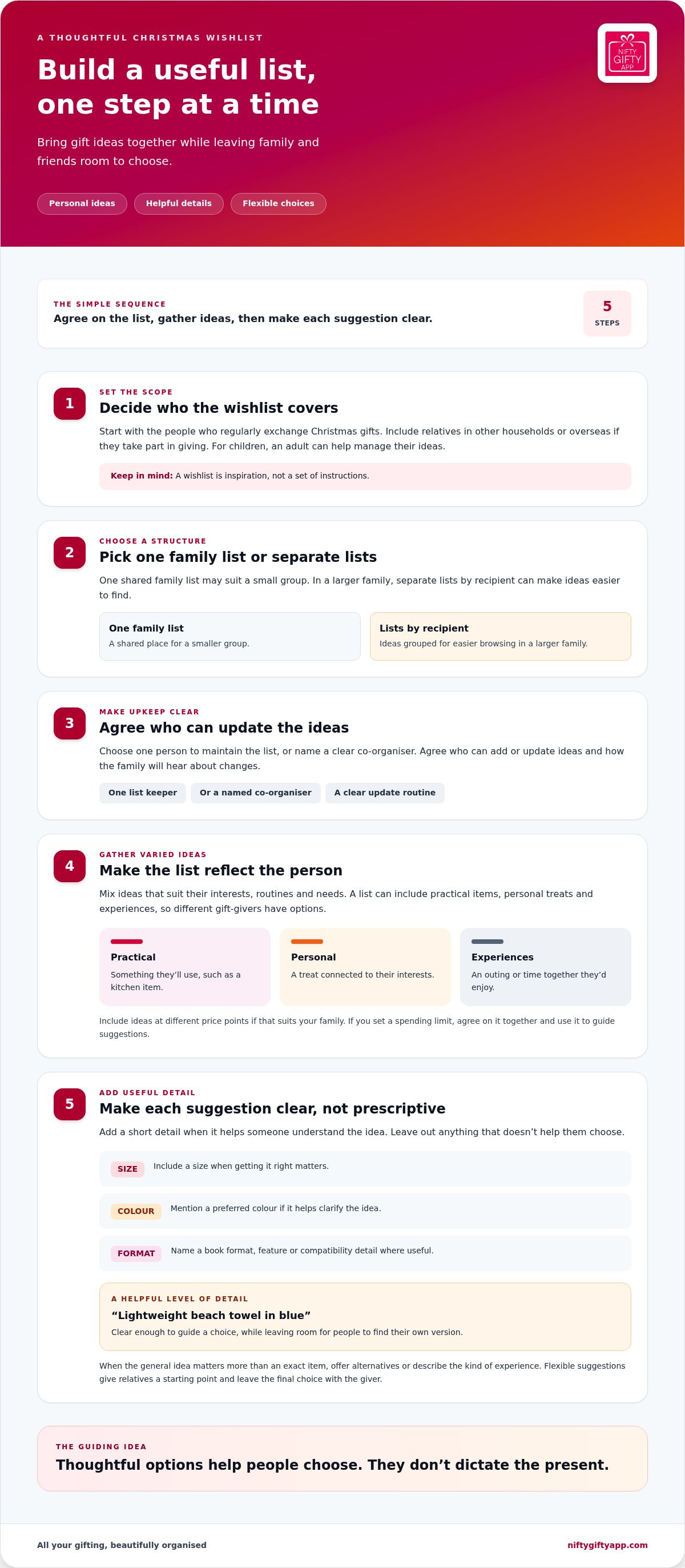
Start with the people who regularly exchange Christmas gifts, then decide how to group the list. One shared family list may suit a small group; separate lists by recipient can make ideas easier to find in a larger family. Include relatives in other households or overseas if they take part in giving. Agree on one person to maintain the list, or name a clear co-organiser, so updates don’t end up in competing versions.
Before collecting suggestions, settle a few simple ground rules together:
Decide whose preferences belong on the list, including children if an adult will help manage their ideas.
Choose whether everyone will use one family list or a separate list for each recipient.
Agree who can add or update ideas, and how the family will hear about changes.
That shared understanding makes the organiser’s role clearer. People know where to contribute ideas and where to look when they’re ready to choose. It also helps keep preferences current, so an old suggestion doesn’t become the only option relatives see. Once you’ve agreed on the list’s purpose and who it covers, you’re ready to make the ideas useful.
What to put on a Christmas wishlist so gift ideas are useful
A helpful list reflects the person, not whatever happens to be popular this year. Include a few types of ideas: practical things they’ll use, personal treats that match their interests and experiences they’d enjoy. Variety gives relatives room to choose something that suits their relationship with the recipient and what they have in mind.
Think about the person’s everyday routines and the things they’ve mentioned wanting to try. Someone who loves cooking might appreciate a useful kitchen item, while a keen reader may enjoy a book or a voucher for an activity. Include ideas at different price points if that suits your family. If you’re setting a spending limit for family gifts, agree on it together and use it to guide suggestions, rather than making each item feel like an expectation.
Choose ideas that reflect the recipient
Start with their hobbies, daily needs and passing comments. Add practical items alongside thoughtful treats when they suit the person. A summer-friendly idea might be something for beach days, gardening or outdoor cooking, but don’t assume everyone enjoys the same activities or celebrates in the same way. Keep the list personal, and include experiences if time together would mean more than another object.
For example, a keen gardener might like sturdy gardening gloves, a native plant or a visit to a garden they’ve been meaning to see. The aim isn’t to prescribe an exact present. It’s to help gift-givers recognise the interests behind the idea. The psychology of gift-giving offers another perspective on why a thoughtful choice can matter to both the giver and recipient.
Add enough detail to make each idea clear
A short detail can stop a good suggestion becoming a guessing game. Note a clothing size, preferred colour, book format or relevant compatibility detail when it helps someone understand what the recipient has in mind. For instance, “lightweight beach towel in blue” says more than “towel” without dictating a shop or brand. Keep descriptions brief and leave room for people to find their own version.
Include a size or colour where getting it right matters.
Name a format or feature that distinguishes similar options.
Offer alternatives if the general idea matters more than the exact item.
Leave out details that don’t help someone choose.
Prefer the feel of a cosy read to one particular title? Say so. Interested in a day out, but not a specific venue? Describe the kind of experience. Flexible suggestions can still be useful. They give relatives a starting point while leaving them free to choose how to bring the idea to life.
As you decide what belongs on the list, keep the family’s spending plan in view. A mix of modest and more substantial ideas helps people choose what works for them. Nifty Gifty App gift lists help you organise ideas for family gifting in one place.
How to set up a Christmas wishlist step by step
The easiest way to set up a Christmas wishlist is to work through it in order. Decide who the list is for, collect ideas as they come up, then check each entry before sharing. If an idea comes up in a chat, at the shops or during a family catch-up, record it straight away. Memory is handy, but it’s not a reliable filing system.
Gather ideas and organise them by recipient
Start by choosing whose gift ideas belong on the list. For a family list, label each person clearly so a suggestion for one recipient doesn’t get mistaken for another’s. If relatives are in separate households, include everyone who takes part in your gift exchange, whether they live nearby or further away.
Next, gather what’s already been shared. Look through family messages, personal notes and conversations, then ask each recipient for a few preferences if needed. Record ideas in one working place as they arise, rather than leaving them in separate chats to find later. A note such as “Mia mentioned a pottery class” is a useful starting point. Add a detail if it helps explain what she had in mind.
Review the list before sharing it
Before sharing the list, read it as if you’re a relative who hasn’t heard the original conversation. Could they understand what each idea means? Check that details are clear, similar suggestions aren’t accidentally repeated and alternatives still suit the recipient. Remove ideas that are outdated or no longer feel right. This quick review helps the list reflect current preferences, not last Christmas’s plans.
Use this sequence to turn scattered suggestions into a list people can act on:
Choose the recipients. Decide who will have gift ideas included and how you’ll label each person.
Collect what you know. Check existing notes and family conversations, and invite recipients to share interests or preferences they’d like others to know.
Record ideas as they arise. Add suggestions to the working list promptly, with the recipient’s name and any useful context. This helps when relatives share ideas across different chats or households.
Clarify and sort. Remove outdated suggestions, make vague entries more specific and keep ideas under the right person. If two entries sound alike, check whether they refer to the same thing or are useful alternatives.
Review before sharing. Read each entry for clarity, check that preferences are current and make sure the list offers ideas rather than instructions.
A review from the recipient’s point of view can be revealing. The behavioral science of gift selection considers how gift-givers and recipients can see choices differently. Check that the ideas reflect what the person actually enjoys, rather than what you assume they should enjoy. If an entry feels too vague, ask a simple follow-up or leave it off until you can describe it clearly.
Choose the recipients, gather and record ideas, clarify each entry, then review the list before sharing. That gives the family organiser a repeatable process, whether suggestions arrive over dinner or from relatives in another time zone.
How to share a Christmas wishlist without making it feel like a demand
Sharing gift preferences can feel awkward. You want to help relatives choose, not hand them a shopping order. Present the wishlist as optional inspiration and make it clear that a thoughtful alternative is welcome too. That gives people useful direction while leaving the choice, and the pleasure of giving, with them.
Share the list with a little context
Send the list through the family channel people already use for updates, whether that’s a group chat or email. Add a short note explaining why you’re sharing it. Keep the tone warm and low-pressure, and avoid language that suggests anyone is expected to choose from the list.
For example: “We’ve gathered a few ideas to make Christmas gift choosing easier. Please treat them as inspiration, and feel free to choose something else you think they’d enjoy.” This explains the list’s purpose without making anyone feel obliged to follow it.
For relatives in different households or countries, point everyone to the same list for updates. That way, family members aren’t relying on forwarded messages or an old version of someone’s notes. A shared list also lets relatives in different time zones check the ideas when it suits them, rather than needing to catch the organiser online.
Keep the list current after sharing
A wishlist is more helpful when it reflects what the recipient wants now. If an idea no longer suits them, remove it or mark it clearly as outdated. If you change or replace a suggestion, tell the family through the channel where you shared the list. A short update helps people act on current information without comparing old and new messages.
Keep updates purposeful. You don’t need to repeat the whole list whenever one detail changes. Mention what’s different and, if useful, where to find the latest version. Avoid sending regular reminders just to prompt a purchase. A timely note is enough when an idea has changed or needs clarification.
Explain that the list is there to make choosing easier, not to set expectations.
Make clear that relatives can choose another thoughtful gift.
Share changes in the family’s usual communication channel.
Keep any update brief, relevant and easy to act on.
If your family is also keeping an eye on spending across occasions, a gift budget tracker can help make those plans easier to follow. Let the wishlist support the conversation, not take it over. Create a Christmas wishlist with Nifty Gifty App.
Keep a Christmas wishlist organised with Nifty Gifty App
Once your family’s ideas are ready, give them a home that’s easy to maintain. Nifty Gifty App helps organisers bring recipient lists together and keep occasion planning in view, so you can focus on choosing ideas that suit your family.
Set up and share the list in Nifty Gifty App
Organisers create and manage lists in the Nifty Gifty App mobile app on iOS or Android. Create a list for Christmas, add the recipients, then enter gift ideas under the right names. As plans develop, review each person’s suggestions and keep the list aligned with their current interests.
If you’re organising gifts across several households, agree who’ll look after the list and make updates. That gives family members a clear point of reference and helps the organiser keep each person’s ideas in the right place. Use the occasion budget tools to keep your Christmas plans in view alongside the list.
Coordinate claims and group gifts
Share the list using a secure link or QR code. Guests can claim gifts in real time without downloading the app or creating an account, while recipients receive the gifts. Keeping the list current helps relatives make informed choices and can help avoid duplicate gifts.
If your family is planning a present together, use Nifty Gifty App’s contribution tracking to keep the group’s progress visible with a live running total. Contributors arrange payments separately because the app doesn’t collect or process them. This keeps the coordination record in one place while leaving payment arrangements with the family.
Keep each recipient’s Christmas ideas grouped together.
Choose who will maintain the list and keep suggestions current.
Use occasion budget tracking to keep spending plans in view.
Record group gift contributions as relatives coordinate a shared present.
If you’re comparing apps to organise Christmas presents, consider how each option fits the way your family plans, updates gift ideas and coordinates shared presents. Choose an approach that supports the organiser without making gift giving feel like a task list.
For the person who usually keeps everyone’s gifting plans on track, Nifty Gifty App brings Christmas lists, occasion budgets and group contribution tracking together. All your gifting, beautifully organised.
Make your family’s next occasion easier to organise
Give your wishlist a small follow-up after Christmas. Notice which ideas felt personal, which details helped relatives choose and what the recipient genuinely enjoyed. Keep those preferences handy for the next occasion, then refresh them rather than starting from scratch. Tastes change, and last year’s favourite isn’t automatically this year’s idea.
That simple habit can make setting up a Christmas wishlist feel less like a yearly project and more like a natural part of family gifting. You don’t need a long list or a perfect plan. A few current ideas, shared with care, can give loved ones a useful starting point while leaving them room to surprise the recipient.
Nifty Gifty App gives family organisers a place to bring gift ideas together as plans take shape. Start your 14-day free trial, then continue for $7.99 a year. Explore Nifty Gifty App for your Christmas wishlist.
Frequently Asked Questions
When should I start setting up a Christmas wishlist?
Start when family members begin asking for gift ideas, ideally before relatives are ready to purchase presents. You don’t need to finish the list all at once. Add suggestions as they come up, then give family time to look through them, especially if people are coordinating across households or time zones. A living list can grow gradually, so useful ideas don’t depend on remembering every passing comment at Christmas time.
What can I do if I cannot think of Christmas wishlist ideas?
Look at what the person uses, enjoys or talks about during an ordinary week. Ask yourself what they’ve mentioned replacing, learning or doing more often. If you’re wondering how to set up a christmas wishlist when ideas aren’t coming, try asking the recipient a few open questions, such as what would make their routine easier or what they’d like to do together. A helpful answer might be a category or experience, not a specific item.
Is it all right to include practical things on a Christmas wishlist?
Yes. Practical gifts can feel thoughtful when they suit the recipient and make daily life easier. Include something they need or would use regularly, rather than assuming a Christmas gift has to be purely decorative or surprising. If the item is personal, such as clothing or equipment, add the detail that helps relatives choose appropriately. You can balance useful suggestions with a few treats or shared activities for variety.
How can I make a Christmas wishlist when I do not want one exact present?
Describe the kind of gift you’d enjoy instead of naming one exact product. You could suggest a genre of book, a relaxing activity or something that supports a hobby, then let the giver choose the particular version. You can also explain what you like about the idea, such as wanting a quiet afternoon out. That gives family members a clear direction without narrowing their choices to one item.
Can I set up a Christmas wishlist for adults as well as children?
Absolutely. Adults can share their own interests and preferences, while a parent or carer can help gather ideas for a child. For younger children, focus on things they enjoy playing with or activities they’re excited about, and let the adult check that suggestions are suitable. Keeping recipients clearly labelled helps relatives tell whose ideas they’re viewing, particularly when several people in the family have similar interests.
What should I do with a Christmas wishlist after the celebrations?
Review it while the season is still fresh. Remove one-off ideas that no longer matter, and note preferences that are likely to remain useful, such as a hobby or favourite kind of experience. You can also jot down what the recipient especially enjoyed, so future gift planning starts with real clues rather than guesswork. Before the next occasion, check that saved ideas still fit their current interests and circumstances.


Comments