
How to Reduce Christmas Mental Load: A Practical Guide

What if the tiring part of Christmas isn’t the day itself, but remembering every gift, meal, event and family message that needs sorting beforehand? If you’re trying to work out how to reduce christmas mental load, start by recognising that the planning is work too. It shouldn’t all sit in one person’s head.
It’s easy to become the person who notices what’s missing, decides who’ll handle it and follows up when plans change. Then simplifying dinner or declining an invitation can feel like letting everyone down. It isn’t. A good Christmas doesn’t depend on doing everything or meeting every expectation.
This guide will help you bring hidden tasks into view, choose what genuinely matters and give each job a clear owner. You’ll find practical ways to set realistic expectations, share the organising and protect time for the moments you want to enjoy. We’ll also cover gift coordination as one manageable part of the bigger picture, so fewer details have to stay in your head.
Table of Contents
What is Christmas mental load, and why can it feel so heavy?
How to reduce Christmas mental load: map every task before making plans
What should you keep, simplify or share to make Christmas easier?
How to make a Christmas plan that reduces decisions and follow-ups
How Nifty Gifty App can help organise the gift-planning part
What is Christmas mental load, and why can it feel so heavy?
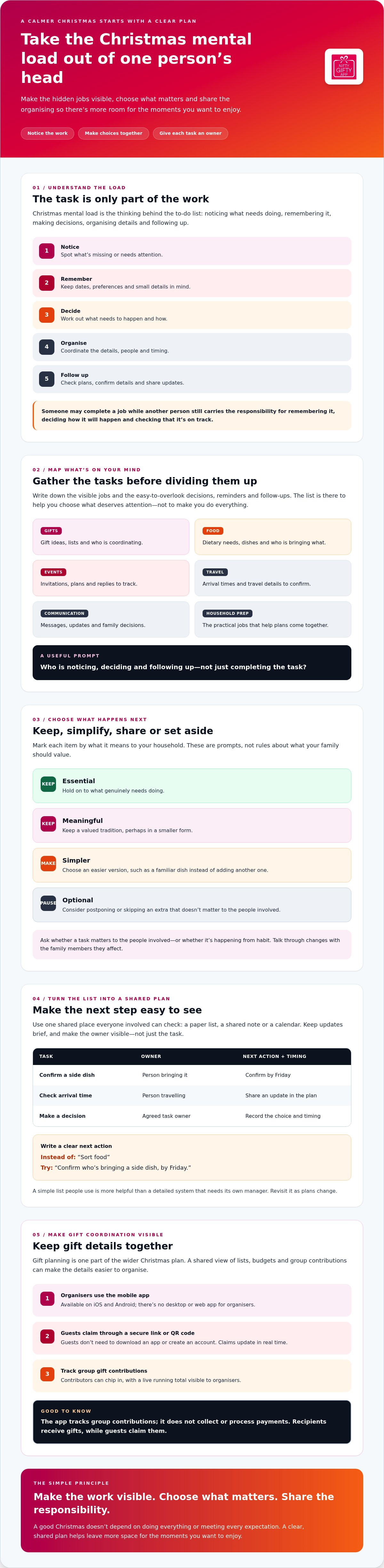
Christmas mental load is the work of noticing what needs doing, remembering it, making decisions, organising the details and following up. It’s the thinking behind the task list, including jobs that haven’t made it onto paper yet. The idea of mental load is often explained as the responsibility of keeping household needs in mind, not simply completing individual chores.
Festive plans can spread that responsibility across many small details. Gifts need ideas, lists and decisions about who’s coordinating. Food can mean checking dietary needs, planning dishes and working out who’ll bring what. Travel may involve confirming arrival times, while events and family communication bring invitations, replies and updates to track.
The visible job is only part of the work. Someone may prepare a meal, wrap a present or drive to a gathering, while another person remembers it needs doing, decides how it will happen and checks that it’s on track. That behind-the-scenes responsibility is easy to miss, especially when the day itself seems to run smoothly.
What counts as invisible Christmas work?
It includes checking whether guests have dietary needs, remembering a relative’s gift idea from a conversation weeks ago and confirming when everyone expects to arrive. It can also mean noticing that a plan needs a decision, asking someone to take it on and following up. Even if another person completes the task, the person keeping it in mind may still be carrying the responsibility.
Why can the load feel uneven in a family?
One person can become the default planner through habit. They may usually remember dates or know what family members prefer, so others wait for direction without agreeing that this is the arrangement. Each reminder and small decision adds another detail to hold in mind. If this feels familiar, you’re not failing at Christmas, and you don’t have to create a perfect celebration.
Not every household celebrates Christmas in the same way, and there’s no single correct list of festive jobs. Ask who is noticing, deciding and following up. Naming that work makes it easier to see what’s genuinely needed and what can be shared or left out. If you’re wondering how to reduce christmas mental load, start by recognising the thinking as part of the work, not an invisible extra.
How to reduce Christmas mental load: map every task before making plans
Before dividing up Christmas jobs, get the full picture out of one person’s head. A quick audit shows what needs doing, which decisions are still open and where reminders keep landing. This isn’t a demand to do everything. It’s a way to choose what deserves attention.
Try this short sequence:
Empty your head. Write down tasks, decisions, reminders and follow-ups, including small details that are easy to forget.
Group the list. Use gifts, food, events, travel, communication and household preparation as categories. Add or change categories to suit your plans.
Mark each item. Label it essential, meaningful, optional or suitable to simplify. These are prompts, not rules about what your family should value.
Add the next action and timing. “Confirm who’s bringing a side dish, by Friday” is easier to act on than “sort food”.
Choose what happens next. Assign an owner, agree to simplify it or set it aside. You can revisit the list as plans change.
How do you get Christmas tasks out of your head?
Choose one shared place everyone involved can check, such as a paper list on the fridge, a shared note or a calendar. Avoid keeping half the plan in messages and half in memory. Give each task a clear next action and realistic timing, then keep updates brief. A simple list people use is more helpful than a detailed system that needs its own manager.
For tasks involving others, make the owner visible, not just the job. “Check arrival time” could belong to the person travelling, rather than leaving the organiser to chase everyone. That small shift makes responsibility easier to share.
How do you decide what can wait or be dropped?
Ask whether the task matters to the people involved, or whether you’re doing it from habit. Keep a genuine need, preserve a meaningful tradition in a smaller form, and consider postponing or skipping an optional extra. You can also simplify a task, such as choosing a familiar dish instead of adding another one for appearance’s sake.
Talk through changes with the family members they affect. You don’t need everyone to want the same Christmas, but a clear conversation can replace unspoken expectations with a plan people understand. Learning how to reduce christmas mental load isn’t about stripping the joy out of the day. It’s about not treating every task as essential.
If gifts are on your list, explore gift-list organising with Nifty Gifty App as one way to make that part easier to track.
What should you keep, simplify or share to make Christmas easier?
Once the Christmas jobs are visible, decide what each one needs instead of assuming everything has to stay as planned. Use four options: keep, simplify, share or skip. They’re prompts for a family conversation, not a formula for how Christmas should look.
Keep: Hold on to a tradition that matters to the people taking part, such as making a favourite family dish.
Simplify: Keep the meaning but reduce the preparation. You might make one part of the dish ahead or serve a smaller menu.
Share: Give someone ownership of a whole outcome, such as organising the drinks and checking what’s needed.
Skip: Let go of an optional extra that nobody is especially attached to, such as an additional activity added out of habit.
A tradition doesn’t have to disappear just because its usual version takes too much effort. Keep the part people enjoy, then adjust the timing, scale or preparation. Family members may value different parts of the season, so ask before changing a plan that affects them.
How can you share responsibility without becoming the project manager?
Handing out an errand can leave you holding the rest of the work: noticing what’s needed, explaining it and checking it’s done. Instead, assign one owner to an outcome. Agree what “done” means, when it’s needed and who will handle follow-up. For example, the person coordinating a shared meal confirms their contribution and updates the group if plans change.
Shared responsibility means sharing the noticing and follow-up, not just the task itself. Set one clear check-in at an agreed time rather than sending repeated reminders. If the owner needs help, they can raise it then. This helps you avoid quietly tracking everyone else’s jobs.
How can you set kind limits on Christmas expectations?
Keep your words warm and direct. Try: “We can’t host this year, but we’d love to join you for lunch,” or “Let’s keep the meal simple so we can spend more time together.” Offer an alternative only if it genuinely feels manageable. You’re allowed to say no without creating a replacement plan.
People may care about different things: one person might love decorating, while another values a relaxed meal. Neither preference needs to set the workload for everyone. Choosing what to keep, simplify, share or skip is a practical way to decide how to reduce christmas mental load while making room for the parts of Christmas your family wants to enjoy.
How to make a Christmas plan that reduces decisions and follow-ups
A shared plan works when it answers three questions: what needs to happen, who owns it and when it’s due. Keep it somewhere the people involved can check, such as a shared calendar or written plan. Then use this sequence:
Agree priorities. Decide which plans matter to your household before adding extra commitments.
Assign an owner. Give each job one person responsible for the outcome and any follow-up.
Set dates. Record when a decision or task is needed, not just the day of the event.
Write down decisions. Capture the agreed choice so it doesn’t need to be remembered or re-decided.
Review once. Choose a check-in that suits your household, update what’s changed and close completed tasks.
What belongs in a low-maintenance Christmas plan?
Include key dates, meal decisions, travel arrangements, gift tasks and the person responsible for each. Add reminders for real deadlines, not a string of status checks. Keep personal or sensitive details in a shared space that’s appropriate for them, rather than making everything visible to every participant.
Keep new requests out of the automatic yes pile. Check the calendar and your capacity first, then reply clearly: “I’ll check what we’ve already committed to and get back to you.” That pause gives you room to make a realistic choice.
How often should you review the plan?
There’s no set review schedule that suits every household. Choose a rhythm based on how many plans are changing. At each check-in, update owners and dates, note new decisions and mark finished tasks as complete. A short review keeps the remaining work easy to scan without turning the plan into another job.
Optional tool for gift coordination
Gifts are one part of the wider plan. A shared gift list can keep ideas and claims visible, which may reduce repeated checking. For a practical overview, read this gift list organiser app guide.
Nifty Gifty App is one optional way to organise gift lists and budgets. Guests can claim a gift through a secure link or QR code without downloading the app or creating an account, and claims update in real time. If that would help with the gifting part of your plan, explore Nifty Gifty App for gift coordination. It’s a tool for gifts, not a plan for every Christmas responsibility.
How Nifty Gifty App can help organise the gift-planning part
Gift planning is one part of Christmas mental load, with small decisions about collecting ideas, tracking who’s claiming what and coordinating a group gift. Nifty Gifty App helps organisers keep gift lists, occasion budgets and group gift contribution totals together. It supports the gifting plan, not every household task.
Which gift-planning jobs can a shared list support?
Add gift ideas to a list and share it with guests. They can claim gifts through a secure link or QR code without downloading the app or creating an account. Claims update in real time, so the organiser can see what’s been claimed and check the list instead of relying on scattered messages.
Organisers use the Nifty Gifty App mobile app on iOS or Android to manage lists and budgets. Budget tools help keep the planned gift budget in view as decisions are made. For a group gift, contributors can add their contributions, and the app tracks them with a live running total. It doesn’t collect or process payments.
What does a gift list app not take care of?
Nifty Gifty App doesn’t sell gifts, arrange delivery or process group payments. It won’t organise meals, travel or family conversations, either. Think of it as support for gift coordination, not a fix for the full Christmas workload. A visible claim can help the organiser keep track, but no list can guarantee there’ll be no duplicate gifts or overspending.
That distinction matters. A tool for one part of the plan can lighten the tracking, while other responsibilities still need clear owners and realistic expectations.
What is one manageable next step?
This week, choose one gifting task to record and share. It could be gathering gift ideas for one recipient or setting up a list for a group gift. Decide who owns the next step, then make the plan visible to the people involved. Keep it small enough to fit around the rest of your Christmas preparations.
That’s the practical heart of how to reduce christmas mental load: share the work, simplify what doesn’t need to be complicated and leave room to enjoy giving. Nifty Gifty App offers one way to keep gifting details together, so the rest of the celebration stays yours to shape.
Make room for the Christmas moments you value
Reducing the Christmas mental load doesn’t mean doing less of what matters. It means making the invisible work visible, choosing what to keep or simplify, and giving each task a clear owner. A shared plan can hold dates, decisions and responsibilities so fewer details rely on one person’s memory.
If you’re thinking about how to reduce christmas mental load, start with one practical step: write down a gifting task and share responsibility for it. For gift lists, Nifty Gifty App lets guests claim gifts through a secure link or QR code without downloading the app or creating an account. Claims update in real time, and group contributions show a live running total. The app tracks contributions but doesn’t process payments.
Gift coordination is just one part of the season, but making it easier to track can leave more attention for time together. See how Nifty Gifty App can organise your gift lists, then keep shaping a Christmas that feels right for your household. You don’t have to do it all to make the day meaningful.
Frequently Asked Questions
What is Christmas mental load?
Christmas mental load is the thinking work behind festive jobs: noticing what needs doing, remembering details, making decisions, organising people and checking plans are on track. It can cover gifts, meals, events and family messages. For example, someone may not prepare the meal but still remember to check dietary needs and confirm who’s bringing each dish. Naming those responsibilities makes them easier to record, discuss and share.
How can I reduce Christmas mental load quickly?
Start with one written list of tasks and reminders you’re holding in your head. Group them, then mark each one to keep, simplify, share or skip. Give shared tasks a clear owner and a realistic due date. If you’re asking how to reduce Christmas mental load, you don’t need to plan every detail at once. One visible list and one useful conversation can make the next step easier to see.
How do I get my family to share Christmas responsibilities?
Make the work visible before asking others to take it on. Explain the outcome needed, agree who owns it and set a date together. Ownership should include noticing and following up, not just completing an errand after reminders. For example, the person coordinating a shared meal could confirm their contribution and update everyone if it changes. Keep the conversation practical, and decide together what to simplify if the plan feels too demanding.
What if I feel guilty about doing less at Christmas?
Pause and ask which parts of the season matter most to you and the people involved. Some traditions may be worth keeping; others can be made smaller, shared or skipped this year. Doing less doesn’t mean caring less. Explain what’s changing in a clear, kind way, such as, “We’re keeping lunch simple this year.” Family members can value different parts of Christmas, so make space for those differences without taking on every expectation.
Can a gift list app reduce Christmas mental load?
A gift list app can support gift planning by keeping ideas and claims visible in one place. With Nifty Gifty App, organisers can share a secure link or QR code, and guests can claim gifts without downloading the app or creating an account. Claims update in real time. The app supports gift coordination, not meals, travel or every family responsibility, so use it as one tool within a wider Christmas plan.
How do I reduce Christmas mental load as a busy parent?
Start by separating tasks only you can do from jobs another household member can own. Put key dates and decisions in one shared place, then agree who’s responsible for each task and when it’s due. Keep traditions that matter, simplify what’s draining time and make sure the owner handles follow-up too. That way, you’re sharing the organising, not becoming the person who has to remind everyone what they agreed to do.


Comments