
How to Plan Gifts for the Whole Year That Suit Their Interests

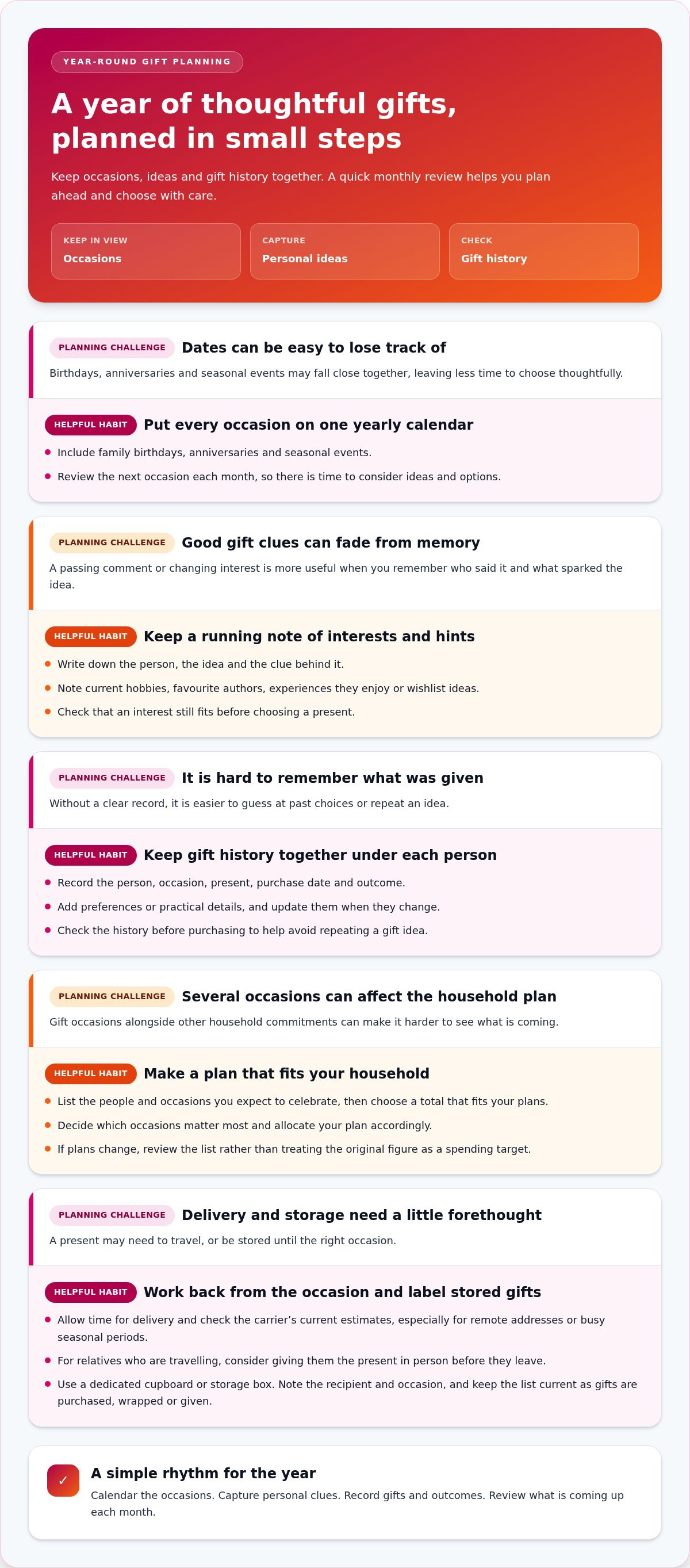
Duplicate gifts are easier to prevent than to explain. To plan gifts for the whole year, keep one calendar of birthdays and seasonal occasions, note gift ideas as people mention them, and record what you’ve bought and given. A quick monthly review helps you see what’s coming before the last-minute rush.
It’s a simple system that makes thoughtful gifting easier. Choose presents around each person’s interests, spread decisions across the year, and keep a clear history so you don’t repeat the same idea.
Build a year-round plan by mapping out occasions, capturing ideas, tracking gifts and preparing for seasonal events in good time. Less guesswork for you, and more room to enjoy giving.
Table of Contents
1. Benefits of buying gifts throughout the year
Buying gifts throughout the year spreads decisions across ordinary shopping trips instead of concentrating them before birthdays and Christmas. Start with a calendar of family birthdays, anniversaries and seasonal events. Review the next occasion each month, so you have time to notice a useful idea or a sale and choose thoughtfully.
Shopping early gives you time to compare options and wait for a sale that suits your plans. It doesn’t mean buying extra presents. Write down the people and occasions you intend to recognise, then stick to that list. If your sister mentions a favourite author in winter, note the title and look at your options before her birthday.
For postage and delivery deadlines across Australia, work backwards from the occasion and allow time for the gift to arrive. Check the carrier’s current delivery estimates for the route, especially for remote addresses or busy seasonal periods. If relatives are travelling, consider giving them the present in person before they leave.
To set a yearly gift budget, list the people and occasions you expect to celebrate, then choose a total that fits your household’s plans. Decide which occasions matter most to your family and allocate the budget accordingly. If invitations or plans change, review the list rather than treating your original figure as a spending target.
To set a per-person limit, consider how many occasions you’ll mark with that person and how each fits your priorities. You might set aside more for a close family birthday and less for a casual gift exchange. Write an amount beside each occasion, then track your spending against the plan.
ASIC recommends marking bills, birthdays and periodic events on a calendar or yearly planner to see when you’ll need more money. This makes it easier to view gift occasions alongside household commitments. A monthly review can show when several events fall close together, giving you time to plan your purchases.
Store gifts bought in advance in one dedicated place, such as a labelled cupboard or storage box. Note the recipient and occasion beside each present, and use separate bags if you store several people’s gifts together. That way, a present for your cousin’s birthday won’t be mistaken for a Christmas gift.
Keep your storage note current as gifts are bought, wrapped or given. A simple list can show what’s ready and what still needs attention. For example, write “Ava, birthday, wrapped” beside the item. Pair the list with your calendar to make year-round buying easier and leave more time for family celebrations.
2. Choosing gifts around the recipient's interests
A thoughtful present starts with something specific about the person, not a generic idea of what they might like. Notice what someone talks about, uses often or makes time for. If your brother keeps recommending Australian crime novels, note an author or title he hasn’t read. If a friend is learning to bake sourdough, a practical baking book may suit them better than another kitchen ornament.
One useful part of planning gifts for the whole year is recording ideas as people mention them. Add the person’s name, the idea and the clue behind it. “Mum mentioned wanting to see a touring play” is more helpful than “something for Mum”. That detail preserves the reason for your idea, even when several birthdays fall close together.
A wishlist can make choosing easier if it reflects the recipient’s current interests. Ask family members to add items, experiences or favourite authors they’d genuinely enjoy. Before choosing, consider what you know: does your nephew still play guitar, or has he moved on to photography? A quick chat with someone close to him can help you find something that fits.
Wishlists are starting points, not instructions to buy every item. Look for the detail that makes an idea personal. If your aunt lists a cookbook, consider whether she enjoys trying new recipes or prefers familiar meals. If a child asks for art supplies, choose something suited to the way they draw, paint or craft. A present connected to an active interest is more likely to be used and enjoyed.
Interests don’t always point to physical gifts. An experience can suit someone who values time out, such as tickets to a play they’ve mentioned or a visit to a local gallery. Choose something that fits their schedule and tastes. For a family member who loves live music, check which artists they actually listen to before choosing an event.
Keep the recipient’s circumstances in mind. A keen gardener with limited outdoor space may appreciate a compact gardening guide more than bulky equipment. Someone who travels frequently might prefer a small, practical item that’s easy to pack. These details help you choose thoughtfully without assuming a bigger present is more meaningful.
If you’re deciding how to plan gifts for the whole year, use each clue to build a shortlist of personal options. Before buying, connect the idea to one clear detail: a hobby, a wish or a conversation. If you can explain why it suits that person, you’re closer to a thoughtful choice. If it feels generic, revisit their recent interests, wishlist or favourite activities.
3. Keeping a history of gifts given and received
A gift history turns last year’s choices into useful clues for the next occasion. Record each person, occasion, present, purchase date and outcome in one notebook or spreadsheet. For example, note that Aunty Jo received a gardening book for her birthday and said she was using it. That short entry helps you remember what went down well, instead of guessing next year.
Keep ideas, sizes and preferences together under each person’s name. Add practical details such as a favourite colour, clothing size, dietary preference or an experience they’ve enjoyed. Date each note and update it when something changes. An entry like “likes native plants, size medium, prefers comedy” is easier to use than scattered messages.
Record gifts as soon as you’ve chosen or bought them, not after the celebration. Include the occasion and a brief description, such as “cookbook, Christmas” or “concert tickets, birthday”. If a present is part of a set, note the title or type so you don’t accidentally repeat it later. This record is especially useful when several family members give gifts.
Note the recipient’s response after they’ve had time to use the present. A quick entry such as “wears the blue scarf often” or “already owned this game” gives you a clear steer for future gifts. You don’t need to rate every present. One honest detail can show whether it suited their interests, routine or available space.
Include gifts you receive, too, if remembering them could help with future plans. Note who gave the gift and what made it enjoyable. If your cousin brought a board game to dinner and everyone played, that might suggest a shared activity for another family gathering. Keep the note focused on the useful clue rather than writing a long review.
Choose a format you’ll actually maintain. A paper notebook works well if you keep it beside your calendar; a spreadsheet makes it easier to search by person or occasion. Use the same simple fields each time: recipient, date, gift, interest, response and follow-up idea. Leave out sensitive details you don’t need to choose a present.
Before making a new choice, scan that person’s past entries. Check whether you’ve already given them a similar book, whether their interests have shifted and whether a previous gift sparked another idea. A thoughtful gift can come from a small detail in the record, not a grand gesture. Update the history after each celebration, and it becomes more useful with every occasion.
4. Planning for seasonal events
Shape your annual gift calendar around the celebrations your family actually observes. Add recurring events such as Christmas and birthdays, then include invitations for weddings, baby showers and graduations as they arrive. Set a reminder for the task, not just the event: “choose a wedding present” gives you a clearer prompt than a date alone in your calendar.
For milestones, let the occasion guide your choice. A new baby may call for something useful for the parents, while a housewarming might suit a small item for the home. Check the invitation for preferences, then save those details with the event. This keeps your choice connected to the celebration rather than relying on a generic idea.
Christmas planning has its own Australian rhythm. Summer holidays, family travel and shared lunches can change when you see people. Write down who’ll be at each gathering and whether you’ll exchange gifts there. If your cousin is visiting before Christmas, you could bring their present to that catch-up rather than arranging a separate handover.
For friends and relatives in different cities, decide early whether you’ll hand over or post a gift. Keep the recipient’s location and the occasion together in your notes, then check delivery estimates for the route before choosing a posting date. A present for an interstate baby shower may need a different plan from one you’ll take to a local birthday dinner.
Invitations often offer useful clues. A wedding invitation may mention a shared gift list, while a baby shower invite might name a theme. Save the relevant detail, such as “nursery books” or “couple prefers experiences”, beside the event. If the invitation changes, update your note so you’re working from the latest plan.
Make seasonal preparation manageable by grouping similar tasks. Before Christmas, you might set aside one session to choose gifts for relatives you’ll see together. For a run of winter birthdays, gather the ideas in one place and decide what needs attention first. Keep each task specific, such as “choose a card for Sam” or “wrap present for Gran”.
A useful calendar shows more than dates. Add who the event is for, how you’ll celebrate and the next practical action. Review upcoming events when invitations or family travel plans change. With those details recorded, you can adapt your gift plans to the season and the people involved while keeping each celebration personal.
A gift planner can remind you about important events in time to choose and pick up a present. Each reminder gives you a clear prompt and helps keep the task from slipping behind other seasonal preparations.
Planning a few weeks ahead can ease seasonal shopping stress. Use each reminder to check what still needs to be bought, leaving room to adjust if plans change. Reviewing upcoming events helps keep gift choices and collection tasks on track, with time to finish each step before the occasion.
5. Avoiding duplicate gifts
Duplicate gifts often happen when family members plan separately, forget past presents or choose the same obvious idea. Before buying, check the recipient’s gift history and ask whether someone else is organising a present. A quick message to your siblings can prevent two people from choosing the same cookbook for Dad’s birthday.
Keep a clear record for each occasion, not just a general list of ideas. Note the recipient, event, gift and whether it’s an idea, bought or already given. For example, write “Ella, Christmas, watercolour set, purchased” rather than simply “art supplies”. Specific descriptions help distinguish similar items and make your notes useful during busy holidays.
For shared family gifts, name one organiser and keep the plan visible to everyone involved. Agree on the gift before anyone buys it. If cousins are choosing a present for Nana, one person can record the selected item and update the group. This gives relatives a simple place to check before making separate plans.
Use a quick repeat-check before you commit to an idea:
Search the recipient’s past gift entries for the same item or category.
Check whether another family member has mentioned a similar present.
Confirm that a saved idea still suits the recipient’s current interests.
Mark the chosen gift as planned, then update its status after purchasing.
Categories matter because different gifts can still feel like repeats. If your brother received a coffee grinder last year, another coffee accessory may be less useful, even if it’s a different model. Check what he already owns and whether he’s expressed interest in expanding that hobby. A note like “coffee gear, already has grinder” gives you a practical prompt to choose another direction.
For children, record sets, titles and versions. A board game expansion may not work without the original game, while a book series can be easy to duplicate when relatives choose independently. If several people are giving gifts, share the exact title or item description. Clear details make coordination easier than broad labels such as “game” or “book”.
After a birthday or Christmas, update the record while the details are fresh. Note duplicate gifts, exchanges or items the recipient already owned, then use that information before the next occasion. This small follow-up helps make future gifting more personal and considered. To organise shared gift plans and keep choices visible, set up a gift list.
A fuller gift history becomes more useful over time: note what was given, when it was given and what the recipient enjoyed most. This helps distinguish a genuinely new idea from a repeat, while the recipient’s preferences guide more personal choices. Record gifts you’ve already bought, too, so you don’t accidentally buy the same kind of present again.
For year-round shopping, set your budget and buying criteria before adding ideas or making purchases. Keeping them in view can help prevent gift shopping from getting out of control. Track gift spending alongside your records, and check planned gifts and costs before committing to another purchase.
Nifty Gifty App
Nifty Gifty App keeps family gift lists and occasions organised in one place. It’s useful for coordinating presents across birthdays, Christmas and other celebrations, especially with relatives in different cities. Organisers use the mobile app on iOS or Android to manage lists. Guests can claim a listed gift through a secure link or QR code, without downloading an app or creating an account. Claims update in real time.
For a shared present, contributors can arrange contributions directly with the organiser, while the app tracks them with a live running total. Nifty Gifty App doesn’t process payments. Keep gift plans visible and help avoid duplicate choices, while adding the personal details that make each present thoughtful.
Visit the Nifty Gifty App website to explore organising your family’s gift lists.
Make your next occasion the starting point
A year-round gifting habit doesn’t need a grand reset. Start with the next occasion on your calendar and make one small decision today. Choose a note-taking method, save an idea or agree with family on who’s coordinating a shared present. That first step gives you something practical to build on.
As you decide how to plan gifts for the whole year, keep the process flexible. People’s interests change, plans shift, and a thoughtful present doesn’t have to be elaborate. Use your system as a prompt, then bring your own knowledge of each person to the choice.
If you’d like a dedicated place to organise family gift lists and shared plans, explore Nifty Gifty App. Give your next occasion a little thought now, and you’ll be ready to celebrate with more ease when it arrives.
Frequently Asked Questions
Which Australian holidays and occasions require gifts each year?
No Australian holiday legally requires you to give a gift. Families often exchange presents at Christmas, and some mark Mother’s Day, Father’s Day or Easter with a small gesture. Birthdays, anniversaries, weddings, graduations, housewarmings and baby showers are personal occasions where gifts may be welcome. Choose based on your relationships, family traditions and budget. You can mark an occasion with a card, shared meal or thoughtful message instead.
What are thoughtful low-cost and DIY gift ideas for different occasions?
Choose a small gesture linked to the recipient or event. For a birthday, make a playlist of someone’s favourite music or bake a familiar family recipe. For a new home, offer a handwritten list of local walking spots or prepare a simple pantry mix. At Christmas, create a photo card featuring a shared memory. For a wedding, write a note recalling a moment you value about the couple. Personal detail makes even a modest gift feel considered.
How to set a per-person gift budget based on income
A common rule of thumb is to set your annual gift budget at 1-2% of take-home pay. Then allocate it across the people and occasions you plan to celebrate, giving more to higher-priority occasions and tracking spending against each amount.



Comments