
Group gift running total: Suggest a fair amount per person
A fair group gift contribution is usually a suggested range, not a fixed bill. For most Australian group gifts, A$20 to A$50 per person is a comfortable guide, and a group gift running total helps you see how contributions are adding up against the gift’s cost. To set a target, divide the intended gift price by the number of people you’re inviting.
Collecting contributions can feel awkward when nobody knows what’s expected or what the group has raised. Keep the amount optional, explain the suggested range and let people contribute privately, without comparing who gave what.
This guide explains how to suggest a fair amount, track a group gift running total and choose a gift that fits the budget. It also covers practical ways to manage different occasions, from a team birthday to a family celebration, so the gift feels thoughtful and contributing feels comfortable.
Table of Contents
Visible running totals for organisers
A visible balance shows whether contributions are keeping pace with the gift plan and helps you decide what to do next.
Calculating the contribution total
The contribution total is the sum of the amounts people have contributed towards a shared gift. It lets the organiser compare the current balance with the gift’s cost before deciding what to buy.
Record each contribution once, then add the entries to find the current total. If Asha contributes and Ben contributes later, include both amounts in the same calculation. Keep the intended gift cost separate, so it’s easy to see the gap between the target and contributions recorded.
A running balance changes as contributions are recorded. After each update, check that the new entry hasn’t already been counted. If someone changes their contribution, edit the original entry rather than adding another. This keeps the total accurate when you choose the gift or explain the budget to the group.
Tracking contributions in a spreadsheet or app
A spreadsheet or app gives you one place to record contributions and the current balance. That matters because updates across email and group chats are easy to miss.
Use clear fields for contributor, amount and status. A spreadsheet can total the amount column, while an app may update the running balance as contributions are entered. Keep notes brief, and mark an amount as received only when it has arrived. This helps distinguish a promised contribution from money available to spend.
Choose one place as the working record and update it whenever a contribution comes in. For a spreadsheet, limit editing access to the organiser or another trusted helper. With an app, check that the displayed balance reflects recorded contributions, not expected ones. Review updates before sharing them to catch duplicate entries or missed changes.
Sharing the balance and contribution list
Share the overall balance with the group, but keep individual contribution details private. This helps colleagues and relatives avoid feeling compared by what they give.
To share the balance while protecting privacy, send the total without naming contributors or listing individual amounts. For a workplace collection, make participation optional and keep contributions private by default. A brief email or group chat update can say whether the total is on track for the gift budget.
If someone asks for the contribution list, share only the details they need to help organise the gift. For example, a co-organiser may need to know which entries are recorded, while the wider group only needs the current balance. Avoid posting names beside amounts in a public chat. On Monday, a short update can confirm the balance and the next decision without exposing anyone’s contribution.
Before choosing a gift, compare the latest total with its intended cost. If the balance has changed, explain what that means for the plan. A clear total, a private record and a timely update help the organiser make a decision based on contributions actually recorded.
How do you calculate a group gift contribution total?
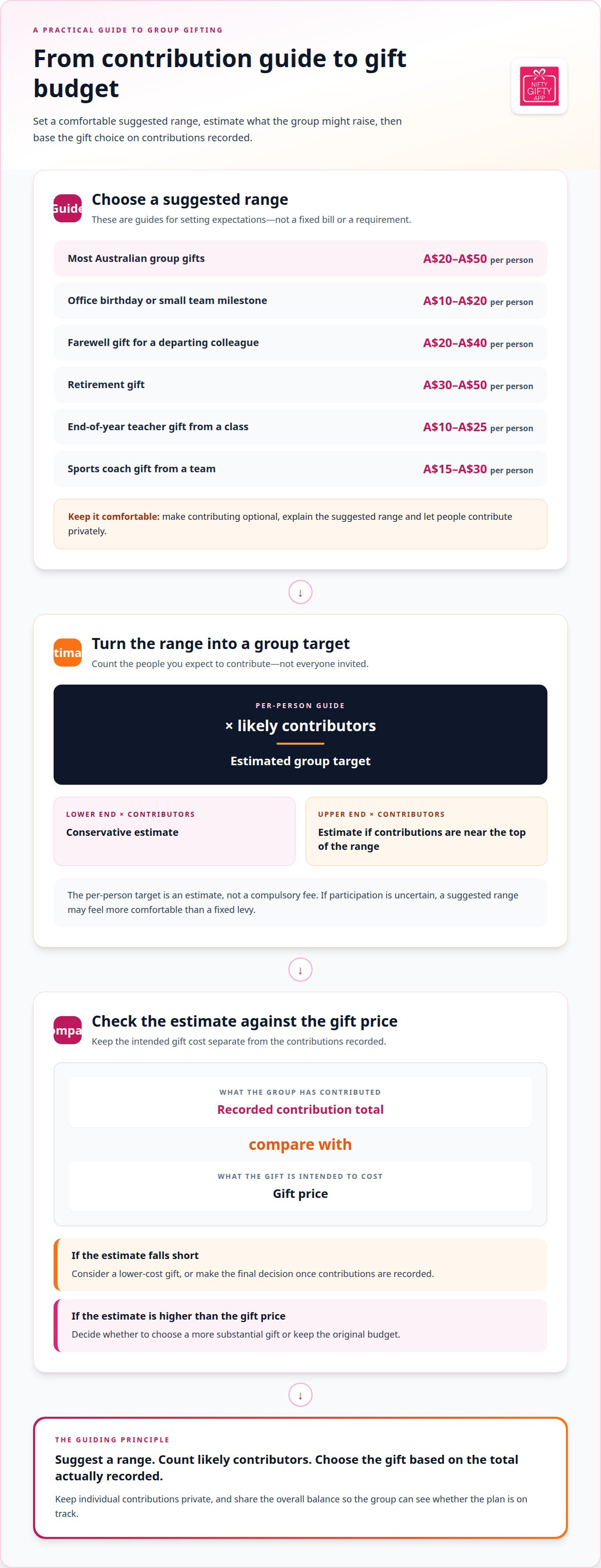
Start with the intended gift price, then divide it by the number of people you expect to contribute. This gives you a per-person target, not a compulsory fee. For a more flexible plan, suggest a range and compare contributions recorded with the gift budget as they come in.
Base the calculation on the actual gift decision. If the group has a specific present in mind, use its price as the target. If the group is still deciding, agree on a budget range first. That way, you won’t set a contribution amount around a gift the group may not choose.
Use the number of likely contributors rather than assuming everyone invited will take part. Contributions should be optional, and people who opt out shouldn’t be followed up. If participation is uncertain, a suggested range may feel more comfortable than a fixed levy.
Australian contribution guides vary by occasion. For most group gifts, A$20 to A$50 per person is a comfortable range. An office birthday or small team milestone may suit A$10-A$20 per person, while a farewell gift for a departing colleague may suit A$20-A$40. These are guides for setting expectations, not a requirement for every group.
For a retirement gift, use A$30-A$50 per person as a suggested range.
For an end-of-year teacher gift from a class, consider A$10-A$25 per person.
For a sports coach gift from a team, consider A$15-A$30 per person.
To turn a per-person range into a group target, multiply each end of the range by the number of people you expect to contribute. The lower result is a conservative estimate; the higher shows what the group might raise if contributions are near the top of the range. Make clear that each person decides whether and how much to contribute.
Compare the expected total with the intended gift price. If the estimate falls short, consider a lower-cost gift or explain that the group can decide once contributions are recorded. If it’s higher, decide whether to choose a more substantial gift or keep the original budget. A group gift running total makes the comparison easier as contributions come in.
For example, a class organising a teacher gift can use the A$10-A$25 range to set expectations, then base its final choice on the contributions actually received. That keeps the calculation connected to the occasion, the group’s comfort and the available budget.
How can you track group gift contributions in a spreadsheet or app?
A single record helps the organiser track contributions and changes to the balance. A spreadsheet gives you control over its columns and formulas. An app may update the displayed total as contributions are recorded, making progress easier to follow between updates.
For a spreadsheet, create columns for contributor, amount, status and date recorded. Keep the gift budget in a separate cell. The total formula should add recorded contributions only, not amounts someone has said they might give. This keeps available contributions separate from expected ones.
Contributor: Use a name or private reference that the organiser can recognise.
Amount: Enter the contribution received, using Australian dollars.
Status: Mark whether it is pledged or recorded as received.
Date recorded: Note when the entry was added or changed.
If Asha’s contribution is pledged first and arrives later, update the status of that entry. Don’t add a second row for the same contribution. If Asha changes the amount, edit the existing record and recalculate the total. This makes duplicate entries easier to spot and explains why the balance changed.
An app can suit a group that needs updates from different places, especially when relatives live far apart. Look for a clear distinction between contributions recorded and amounts still expected. If the app shows a live total, treat it as the current recorded balance, not proof that a payment has been collected.
Keep the record focused on organising the gift. A contribution status can help the organiser follow progress, but it doesn’t replace the transfer between contributors and organiser. Keep individual amounts private by default. Share the overall balance with the group, and limit access to names and amounts to those helping coordinate.
Use one working record rather than updating a spreadsheet and an app independently. Two versions can get out of sync when one person edits an amount but the other copy stays unchanged. If a helper takes over, hand over the current record and explain its status labels. A quick review before choosing the gift can catch an outdated entry or a duplicate.
For a family group, the organiser might update the record after checking a message, then share the overall balance in the family chat. For a workplace collection, the organiser can keep individual amounts private and report only the group’s progress. Both approaches provide a useful update without making a public list of who gave what.
Managing fees, delivery and GST for group gifts
Set the group’s target using the full amount payable for the gift, not just its listed price. At checkout, review the order summary for delivery charges, payment or service fees, and any GST information. This shows whether the amount needed differs from the earlier listed price.
Keep each cost separate in your budget. Record the gift price, delivery charge and any fee as distinct items, then add them to find the total required. This makes it easier to explain a changed target between choosing a present and placing the order.
If an organiser selects a gift online and sees a delivery charge at checkout, add it to the gift cost before comparing the required amount with contributions recorded. If a fee appears at payment, record it as another cost rather than quietly reducing the amount available for the present.
GST can affect the displayed price or order breakdown. Use the seller’s checkout summary to understand how GST is shown for that purchase. Don’t estimate GST separately or add it again if the displayed total already includes it. If the summary shows a separate GST line, include it only once in your calculation.
Gift: Record the listed price for the chosen item.
Delivery: Add the delivery amount shown for the order.
Fees: Include a payment or service fee if the checkout applies one.
GST: Follow the order summary and avoid counting a displayed amount twice.
Check the final checkout screen before confirming the purchase. A delivery option or updated order detail may change the amount payable. If the total has changed, update the group budget and explain the difference before using the contributions. Don’t treat an earlier estimate as the final cost.
Separate costs from contributions in your record. The cost list shows what the gift requires; the contribution list shows what the group has provided. Keeping them distinct makes it easier to see whether the balance covers the order and whether the organiser should wait before purchasing.
For a gift sent to another Australian city, include the delivery charge shown for that destination. For local delivery, use the checkout amount for the selected option. In either case, use the seller’s final order summary as the cost reference, then share the revised target with the group.
If contributions exceed the full purchase total, decide how to handle the extra before placing the order. If they fall short, adjust the gift choice or wait for further contributions. Explain the plan plainly so everyone understands how fees, delivery and GST affect the shared budget.
Handling late, missing or extra gift contributions
A contribution arriving after the planned purchase date can change the available balance. Set a clear decision point for choosing the gift, then base that choice on contributions recorded by then. Keep later contributions separate until the group agrees how they fit the plan.
Around half of gifts arrive within a week of a collection’s first contribution. This can help set expectations, but it doesn’t mean every contribution will arrive together. Share the intended decision date when inviting people, so they know when the organiser plans to choose the gift.
If someone hasn’t contributed by the decision point, don’t assume they’ve forgotten. Contributing should be optional, and people who opt out shouldn’t be followed up. Avoid naming people who haven’t contributed in a group chat. A general update can explain that the organiser is choosing a gift based on the current balance.
Record a late contribution separately from earlier pledges. If the gift hasn’t been purchased, check whether the extra amount changes the group’s choice or budget. If the purchase is complete, tell the contributor what the group decided about later contributions. Agreeing on this approach before the deadline can prevent awkward conversations.
Plan for extra contributions too. If the total exceeds the intended gift cost, the organiser can discuss choosing a different gift or using the remaining amount for another part of the occasion. Explain any change rather than deciding on behalf of contributors. A brief group message keeps everyone informed about the updated plan.
Before choosing: Share when the organiser plans to make the gift decision.
At the decision point: Use recorded contributions, not expected amounts.
After purchase: Record later contributions separately and follow the group’s agreed approach.
If there’s a surplus: Explain the options and agree how the extra will be handled.
Keep individual amounts private and share only overall progress. This protects contributors from comparison and keeps the conversation focused on the gift. For a workplace collection, don’t post a list of who has or hasn’t given. One organiser can maintain the private record and send a simple balance update.
If a family chooses a present using contributions recorded by its decision date, a relative who contributes later shouldn’t automatically be treated as having missed out. The organiser can explain whether the purchase is complete and what the family agreed to do with later contributions. Clear timing, private records and a shared plan make late or extra contributions easier to handle.
Nifty Gifty App
Nifty Gifty App tracks group contributions with a live running total, giving organisers a clear view of the gift fund as contributions are recorded. It helps when family updates are spread across chats or relatives live in different cities. Organisers use the mobile app on iOS or Android to keep occasion details and contributions together.
The app tracks contributions but doesn’t collect or process payments. Contributors arrange payments separately, while the organiser uses the total to guide the gift decision. Guests can claim gifts through a secure link or QR code, without downloading the app or creating an account.
If you’d like help keeping a group gift organised, contact Nifty Gifty App.
Make the next occasion feel personal
The amount raised is only one part of a group gift. The thought behind it matters too. Choose something that reflects the recipient’s interests, shared memories or the occasion. A short note from the group can make a practical present feel more personal, even when contributors are spread out.
Use the group gift running total as a planning aid, then let the recipient guide the final choice. A considered gift doesn’t need a complicated explanation. It simply needs to feel right for the person receiving it and comfortable for the people contributing.
For the next occasion, bring the gift plan and its coordination together with Nifty Gifty App. Make room for the celebration, and enjoy giving together.
Frequently Asked Questions
How do you collect money for a group gift in Australia?
Agree how contributions will be paid, such as by bank transfer or cash handed to the organiser. Give contributors a clear payment reference, such as the recipient’s name, so transfers are easy to identify. Keep a private record of contributions received and contact the organiser if a payment can’t be matched. Agreeing on the method upfront helps avoid confusion when several people contribute around the same time.
How do you run an office collection without the awkwardness?
Make the request straightforward and give colleagues the details they need to decide. Name the occasion, explain who is coordinating it and say how people can contribute. Don’t ask colleagues to explain why they aren’t taking part. If someone has a question about the collection, direct them to the organiser rather than discussing another person’s contribution. A calm, consistent approach keeps the focus on recognising the colleague.
How do you set people up to chip in for a gift online?
Give contributors one clear place to find the gift details and instructions. With Nifty Gifty App, an organiser can create a group gift occasion and share its link or QR code. Contributors can open the link in a browser without downloading the app. Include a short note about who the gift is for and how to contact the organiser if someone has trouble opening the page.
How much should each person chip in?
Choose an amount that feels appropriate for the occasion and the group’s relationship with the recipient. A close family gathering may approach the decision differently from a casual social group. The organiser can suggest an amount while leaving room for individual circumstances. If you’re unsure, start with the intended gift and the group’s preferences, then adjust the plan to suit the people involved.
How much should each person give to a group gift?
There isn’t one amount that suits every group. Consider the occasion, how contributors know the recipient and whether the proposed gift feels right for the group. A small circle of close friends may choose a different contribution level from a large extended family. The organiser can explain how the suggested amount relates to the gift.
What should you write when you ask people to contribute?
Keep the message friendly and specific. For example: “We’re putting together a gift for Lee’s new baby. I’m organising it, and the gift idea is a keepsake chosen by the family. Let me know if you’d like to be included, and I’ll send the details.” Adapt the wording to the occasion, name the organiser and make the next step clear. A personal note helps the invitation feel thoughtful.
What is a group gift running total?
It’s the current combined value of contributions recorded for a shared gift. The figure gives the organiser a snapshot to use alongside the gift plan, rather than deciding what to purchase. If the balance changes after someone contributes, the organiser can reassess the available choices. Read the total with its contribution records to understand what it represents.
How can you split a group gift cost fairly?
Agree on the approach before inviting contributions. Some groups prefer equal contributions from those taking part, while others leave amounts flexible. Discuss what feels appropriate for the occasion, without assuming everyone has the same budget. If contributors give different amounts, the organiser can choose a gift that fits the available funds. Clear expectations help keep the decision comfortable for the group.